Chester Growth:
Engineering Local Search Authority
If you operate a business as a Solicitor, Architect, Accountant, Estate Agent, Insurance Broker, or Construction firm across Cheshire East and Cheshire West (CH1-CH4, CW postcodes), your clients research extensively before contacting you. Professional services succeed online through detailed, informative content that answers buyer questions. Search algorithms like Google and Bing reward this Information Gain with higher rankings. We construct SEO strategies that capture high-intent local and B2B searches for these professional sectors.
Why Local SEO Is Different From National SEO?
Local search targets Chester clients searching for nearby services ("solicitor near me"), while national search serves broader queries ("what is conveyancing"). Local firms need location-specific content and Google Business Profile optimization rather than generic national rankings. Chester Growth builds Information Gain by providing precise data relationships competitors lack: connecting your services to Chester landmarks, council processes, and neighborhood specifics.
How Chester Growth Pricing
Differs from Traditional SEO Agencies?
Most Cheshire SEO agencies charge £500-£800/month for traditional SEO tactics. We charge £950+ monthly retainers because we're not doing traditional SEO - we're building semantic authority that Google's AI actually understands.
| What Traditional SEO Agencies Do? | What Chester Growth Does? |
|---|---|
| Monthly blog posts (£500-800/mo) | Semantic infrastructure build (£3,495-9,995 one-time) |
| Basic link building | Entity architecture & knowledge graph positioning |
| GMB posting | GMB as semantic node reinforcement |
| Rent rankings month-to-month | Build digital asset that compounds over time |
| 12-month cost: £6,000-9,600 | 12-month cost: £14,895+ (£3,495 build + £950/mo) |
| Stop paying = lose rankings | Asset remains, maintains value |
We Build Assets,
Not Rental Rankings
Traditional agencies rent you rankings through monthly tactics. We build a semantic infrastructure (Core 30 architecture) that becomes a permanent digital asset - like buying property vs. renting.
Entity Architecture,
Not Blog Spam
£500 agencies write generic blogs hoping for rankings. We engineer your Google Knowledge Graph presence - teaching Google's AI who you are, what you do, and why you're authoritative in Chester.
Compounding Value,
Not Monthly Churn
Traditional SEO requires perpetual payment for results. Our Build + Retainer model front-loads the heavy lifting (£3,495-9,995), then maintains it (£950+/mo) - creating authority that compounds, not resets.
Our £950/month Foundation Retainer IS Your Entry Package
You get comprehensive semantic SEO at Chester pricing. The same systematic authority building London agencies charge £1,500+ for, delivered at regional rates. No fragmented tactics, no premium markups.
Above Budget Agencies (£300-500):
- Comprehensive strategy, not fragmented services
- Better deliverables (semantic architecture, not basic SEO)
- Dedicated support and quarterly strategy calls
Below Premium Agencies (£1,200+):
- More accessible for mid-sized Chester businesses
- Faster client acquisition with competitive pricing
- Room to scale up to Growth (£1,850) or Authority (£3,500) packages
"We're the sweet spot: comprehensive local SEO at £750-950/month - enough to do it right, without paying for what you don't need."
What SEO Strategy Works
for Your Chester Business Type?
Architects
Design-led practices often fail to rank because Google cannot 'see' aesthetics. We translate visual portfolios into semantic data structures.
We target 'Grade II Listed Retrofits' and 'Conservation Area Feasibility' instead of generic terms like 'Residential Architect.' Specificity drives qualified project inquiries.
Chester Growth constructs portfolio silos. We link visual assets, specifically completed retrofits, to local planning policy nodes, such as the Cheshire West Local Plan Part 2. This connection proves technical relevance to the algorithm.
Visual assets require semantic text to rank. We quantify the gap between your image tags and commercial intent.
Our audit identifies 404 errors. Broken nodes waste crawl budget, whereas healthy links preserve authority.
Heavy portfolios slow loading. We measure Core Web Vitals to ensure visual assets do not penalize mobile rank.
We analyze keyword gaps. We identify missing conservation area terms that competitors leverage.
We validate structured data. Missing 'LocalBusiness' markup prevents rich snippet display.
We build parent-child silos. 'Residential' (Parent) supports 'Listed Retrofits' (Child) to concentrate relevance.
Locations define service radius. 'Architects in Chester' pages capture local intent better than generic homepages.
Tags create noise if duplicate. We prune low-value tags to focus equity on core service categories.
Flat structures aid crawling. We ensure every project page is reachable within three clicks.
Hubs aggregate authority. We create 'Sustainability' hubs to link related green projects together.
Images demand alt-text. We describe the 'Grade II sash window restoration' explicitly for the algorithm.
Case studies outperform blogs. We document the 'Problem-Solution' arc of specific projects.
Specs drive technical authority. We list materials and techniques to satisfy expert user intent.
Objective tone builds trust. We reject sales fluff in favor of architectural precision.
Our architects draft the text. We translate your technical notes into SVO-optimized semantic copy.
Heritage bodies carry weight. Links from the 'Victorian Society' validate conservation expertise.
Niche directories validate entity. We secure listings in RIBA and local planning portals.
Reviews verify trust. We encourage client testimonials that mention specific project types.
Social signals verify activity. Traffic from LinkedIn verifies professional relevance to Google.
Local citations prove proximity. We target features in 'Cheshire Life' to signal local status.
Authority builds over cycles. We track 90-day sprints to measure vector movement.
Algorithms update daily. We monitor volatility to distinguish noise from penalty.
Freshness maintains rank. We update project pages with post-occupancy data.
Intent defines value. We prioritize 'Feasibility Study' queries over generic 'Design' traffic.
Depth protects position. We expand the semantic graph to stay ahead of imitation.
Silos organize your projects by category. Instead of one long list, we group 'Listed Buildings' separately from 'New Builds.' This helps Google understand your specializations and rank you higher for specific project types.
Core Web Vitals measure how fast your website loads and responds. Heavy portfolio images can slow your site. We optimize images so potential clients on mobile don't wait 10 seconds to see your work.
Google only checks a certain number of your pages each day. If you have broken links or duplicate pages, Google wastes time on those instead of your best projects. We clean this up so Google focuses on what matters.
Schema is code that tells Google 'This is a business in Chester with these services.' It makes your listing appear richer in search results with star ratings, location, and contact info - making you stand out from competitors.
Architectural authority builds in 90-day cycles. Month 1: technical fixes. Month 2: content creation. Month 3: link building. Real ranking improvements typically show after 4-6 months of consistent work.
Solicitors
Legal rankings depend on E-E-A-T (Experience, Expertise, Authoritativeness, Trustworthiness). Generic blogs destroy trust signals.
We target 'High-Net-Worth Asset Protection' and 'Corporate Litigation Defense' instead of 'Family Law.' We focus on high-margin commercial intent.
We publish authoritative guides that cite specific statutes, such as the Companies Act 2006. Our schema implementation marks up all content with SRA registration data to validate the entity as a regulated practitioner.
Compliance protects rank. We audit content against SRA advertising codes to prevent penalties.
E-E-A-T demands credentials. We verify that every author links to their Law Society profile.
Duplication dilutes trust. We identify boilerplate text that weakens your unique value.
Client portals slow sites. We isolate secure login areas to protect public page speed.
Research happens on mobile. We ensure long-form legal guides remain readable on small screens.
We split intent. 'Family Law' (Parent) divides into 'Divorce' and 'Custody' (Children) for clarity.
Silos establish expertise. 'Corporate' content remains distinct from 'Private Client' to avoid confusion.
Glossaries capture definitions. Defining 'Probate' captures top-of-funnel traffic.
Office pages prove reach. We create distinct pages for 'Chester' and 'Wrexham' branches.
Team pages prove E-E-A-T. We link individual solicitor profiles to their specific practice areas.
Precision builds authority. We use correct terms like 'Decree Nisi' but explain them simply.
Depth wins citations. Comprehensive guides on 'Commercial Leases' attract links from other firms.
Citations validate knowledge. We link to legislation.gov.uk to prove accuracy.
Anonymized cases prove success. We describe the legal mechanism of victory without breaching privacy.
News signals freshness. We interpret regulatory changes to show active engagement.
Awards validate authority. We mark up 'Legal 500' badges with schema.
Local links prove presence. Sponsorship of 'Chester Legal Walk' signals community tie.
Trust is paramount. We implement review schema to show star ratings in search results.
Relevance is key. We target industry journals rather than generic blogs.
NAP consistency is vital. We align Name, Address, Phone across all legal directories.
Conversions measure trust. We track 'Consultation Request' goals.
History aids authority. We leverage your firm's establishment date in schema.
Monitoring protects assets. We disavow toxic links that attack your reputation.
Wikipedia validates entities. We aim for citation in legal articles where appropriate.
Expansion requires new nodes. We add 'Crypto Asset' services to capture emerging markets.
Your website's age shows stability. If your firm has been online since 2005, Google sees you as established. We highlight your founding date to prove you're not a fly-by-night operation.
Competitors can buy spam links pointing to your site to damage your reputation. We monitor your link profile monthly and remove toxic links before they hurt your rankings.
We track how many visitors request consultations or call you. If 100 people visit and 3 contact you, that's 3% trust. We aim to improve this through clearer pricing and credentials.
Google checks if content is written by real experts. For solicitors, this means showing SRA registration, linking author bios to Law Society profiles, and citing actual legislation.
Wikipedia is Google's trusted source. If you're cited in articles about Chester legal landmarks or notable cases, Google sees your firm as genuinely important in your field.
Estate Agents
Agencies dominate when they own the 'Catchment Area' query. National portals miss the hyper-local nuance of specific streets and suburbs.
We target 'Vendor Advice for Conservation Areas' and 'School Catchment Premiums' instead of 'Sell my house.' This captures vendors at the research phase.
We generate hyper-local area nodes. These guides connect property price data to lifestyle entities, such as Estyn-rated schools and transport hubs like Chester Station. This triangulation proves local market dominance.
Generic guides fail. We check if your guides mention specific schools and transport nodes.
Images sell houses. We optimize high-res gallery loading to prevent bounce.
Buyers swipe on phones. We verify map functionality on touch devices.
Sold data proves success. We audit historical sales pages for indexability.
Branches need distinct identity. We check for unique descriptions per office location.
Hierarchy defines scope. 'Chester' (Parent) holds 'Hoole' and 'Handbridge' (Children).
Schools drive premiums. We link properties to catchment area pages.
Sold listings build history. We keep them live but mark as 'Sold' to retain link equity.
New homes need separation. We create distinct sections for developments to target investors.
Tags group features. We use 'Garden' or 'Period' tags to aggregate niche demand.
Detail sells lifestyle. We describe 'south-facing gardens' rather than just 'garden'.
Commuters need facts. We state '45 mins to Liverpool' to satisfy logistical intent.
Vibe defines value. We describe the 'independent cafe culture' of specific streets.
Data proves expertise. We publish quarterly price trend reports for vendors.
Video increases dwell time. We embed tours to signal engagement to Google.
Portals drive traffic. We optimize Rightmove profiles to funnel users to your site.
Sponsorship signals tie. Supporting 'Chester Races' proves local elite status.
Reviews win instructions. We automate review requests at completion.
Press announces growth. We signal 'New Branch Openings' to local media.
Maps verify location. We ensure Apple Maps and Bing Maps data matches Google.
Dominance requires depth. We cover every amenity in a suburb to own the node.
Rankings capture vendors. Top rank for 'Valuation' drives instructions.
Hyper-local wins. We target long-tail 'Street Name' queries that portals miss.
Brand search proves fame. We monitor branded query volume.
Maintenance requires updates. We refresh area guides with new openings.
Catchment areas are school zones that affect property values. Parents search 'homes near [school name].' We create pages showing which properties fall into top-rated school catchments, capturing buyers at research stage.
Link equity is Google's trust score for a page. When you delete sold listings, you lose that trust. We keep them marked as 'Sold' so the page authority stays and helps your whole website rank better.
Bounce is when someone visits your site and leaves immediately. If property photos take 10 seconds to load, buyers leave before seeing them. We optimize images so galleries load fast and buyers stay engaged.
Long-tail queries are specific searches like 'Victorian homes Hoole with garden.' Rightmove targets generic 'Chester houses.' We target these specific phrases that show serious buyer intent and have less competition.
Dwell time is how long someone stays on your page. Video tours keep buyers watching for 3-5 minutes instead of 30 seconds. Google sees this engagement and ranks you higher because users find your content valuable.
Construction
Commercial clients vet construction firms on compliance and capacity. 'Builder' keywords attract low-value residential repairs.
We target 'Commercial Office Refurbishment Chester' and 'Industrial Unit Fit-out.' We position the entity for large-scale tender opportunities.
Chester Growth maps technical certifications, including ISO 9001 and CHAS accreditation, directly to service pages. We build 'Project Feasibility' content that demonstrates logistical competence to procurement managers.
Projects need context. We check if studies mention specific engineering challenges.
PDFs hide content. We convert brochures to HTML to allow crawling.
Technicals prove skill. We audit content for correct industry terminology.
Location proves reach. We verify that project photos contain GPS data.
Logos build trust. We ensure CHAS/ISO badges link to verification pages.
Sector defines client. 'Education' is distinct from 'Healthcare' to target specific tenders.
Services define capability. 'Groundworks' pages capture sub-contractor searches.
Radius proves capacity. We create pages for 'North West' coverage.
People buy people. We profile Project Managers to humanize the firm.
Maps visualize scale. We embed interactive maps of completed works.
Tenders need proof. We detail 'On-time delivery' and 'Budget adherence'.
Safety is non-negotiable. We document specific H&S protocols used.
Assets prove capacity. We list owned plant to demonstrate readiness.
Green builds win. We highlight BREEAM ratings achieved.
Client praise validates. We use quotes from specific Commercial Directors.
Supply chain links validate. Links from 'Travis Perkins' signal trade status.
Membership proves legitimacy. Federation of Master Builders links are vital.
Government links are gold. We aim for mentions in council development news.
Awards signal excellence. We optimize entries for Construction News awards.
Hiring signals growth. Links from job boards indicate active trading.
Intent is key. We differentiate 'Commercial' from 'Residential' structurally.
Flagships build fame. We leverage high-profile wins for PR links.
History proves safe hands. We emphasize 'Est. 1980' in metadata.
CSR builds brand. We document community engagement.
Expansion needs signals. We create assets for new territories.
Entity is how Google identifies your business. We ensure Google knows you're a commercial construction firm, not a handyman service. This means you appear for £500k+ project searches, not £2k shed repairs.
Google can't properly read PDF brochures. When you upload a project PDF, Google misses the details. We convert these to web pages so procurement managers searching for 'Chester commercial refurbishment' actually find your case studies.
Geo-tagging adds GPS coordinates to project photos. When you claim 'North West coverage,' tagged photos prove it. Google verifies you've actually completed work in Manchester, Liverpool, and Chester - not just claimed it.
BREEAM measures building sustainability. Many tenders require it. When we mention your 'BREEAM Excellent' rating, you appear for 'sustainable construction Chester' searches from councils and universities requiring green credentials.
Metadata is hidden text that describes your pages to Google. When we add 'Est. 1980' to metadata, Google understands you're established with 40+ years experience. This helps you rank for searches where stability matters.
Brokers & Insurance
Financial services require clarity. Clients choose brokers who can explain risk vs. reward without jargon.
We target 'Contractor Mortgage Calculation' and 'Director Shareholder Protection' instead of 'Cheap Mortgages.' We filter for complex, high-value cases.
We build interactive calculator assets and 'Risk Matrix' guides. These tools articulate dualities, such as Fixed Rate Stability vs Tracker Flexibility, ensuring full FCA compliance while demonstrating expert utility.
Calculators drive engagement. We ensure they function on mobile and load fast.
Compliance is binary. We verify FCA disclosure visibility on all landing pages.
Clarity converts. We audit descriptions for jargon that confuses users.
Trust signals need prominence. We check placement of Feefo/Trustpilot widgets.
Friction kills leads. We test forms for ease of use.
User type defines path. 'First Time Buyer' is distinct from 'Buy to Let'.
Niche drives value. Specific problem pages attract high-intent users.
Risk defines product. 'Life Insurance' separates from 'Critical Illness'.
Guides nurture leads. We create 'First Time Buyer' hubs.
Comparison aids decision. We structure pages to compare product features.
Clarity wins. We explain 'Fixed' vs 'Variable' impacts on monthly cost.
Access proves utility. We list lender panels to show market reach.
Honesty builds trust. We clearly state risks of 'Interest Only' products.
Scenarios help visualization. We describe 'Self-Employed' approval stories.
Rate changes drive search. We update content when Bank of England rates shift.
Expertise gets quoted. We aim for quotes in 'MoneySavingExpert' or local press.
Volume verifies service. We automate Trustpilot collection.
Networks validate status. Links from your mortgage network prove authorization.
Local trust matters. Sponsoring schools builds family trust.
Consistency protects status. We ensure FCA number is consistent across web.
Local intent prevails. We target 'Broker in Chester' to beat nationals.
Utility attracts links. Good calculators get bookmarked by users.
Statement defines bias. We explicitly state 'Whole of Market' status.
Advisors need profiles. We link content to CeMAP qualified advisors.
Scale needs breadth. We expand into 'Commercial Finance' to widen the net.
FCA rules require you to clearly show fees and risks. If these are hidden in small print, you get fined and Google ranks you lower. We make disclosures visible at the top of every page so clients trust you and regulators approve.
Friction is anything that makes someone quit your form. Asking for 10 fields when you need 3 loses leads. We test forms to ensure mobile users can complete them in under 60 seconds without frustration.
High-intent users are ready to buy now. Someone searching 'bad credit mortgage broker Chester' needs help today. Generic 'mortgage advice' searchers are just researching. We target the ready-to-act searches that convert into cases.
Whole of Market means you search all lenders, not just a panel. When we state this clearly on your site, you appear for 'independent mortgage broker' searches. Clients specifically search for this term to avoid tied advisors.
CeMAP is the mortgage qualification Google recognizes. When we link articles to advisors showing 'CeMAP 3 Qualified,' Google verifies expertise. This helps you rank for complex searches where professional credentials matter.
Accountants
Small businesses need accountants who simplify compliance. Google rewards accountants who explain tax without jargon.
We target 'Limited Company Tax Planning' and 'VAT Return Deadlines Chester' instead of 'Cheap Accountant.' We filter for business owners who need proactive tax advice.
We display ACCA/ICAEW badges prominently and demonstrate Xero/QuickBooks expertise through guides. These credentials prove competence for searches like 'Qualified Accountant Chester.'
Transparency converts. We ensure fixed-fee structures are clear upfront.
Credentials verify trust. We confirm ACCA/ICAEW logos are visible on every page.
Clarity prevents confusion. We audit descriptions to remove accounting jargon.
Scope needs definition. We check that bookkeeping services explain what's included.
Automation attracts modern clients. We verify Xero/QuickBooks integrations are highlighted.
Entity type drives organization. 'Sole Trader Tax' is separate from 'Limited Company Tax'.
Niche proves specialization. 'Landlord Tax' pages attract property investors.
Deadline drives urgency. 'VAT Returns' and 'Self-Assessment' need dedicated pages.
Guides nurture leads. We create 'Starting a Limited Company' hubs with checklists.
Packages simplify choice. We organize 'Startup,' 'SME,' and 'Growth' pricing tiers.
Specificity converts. We detail 'Annual Investment Allowance' savings with examples.
Dates drive traffic. We list Self-Assessment and VAT deadlines with reminders.
Compliance needs clarity. We explain MTD requirements for VAT-registered businesses.
Scenarios prove value. We describe tax saved for 'Contractor' or 'E-commerce' clients.
Budget changes drive search. We update content after Spring/Autumn Statements.
Recognition builds authority. We showcase 'Top 50 Accountancy Firms' listings.
Volume proves service quality. We automate Google Review collection from clients.
Authority validates expertise. Links from ICAEW directory prove membership.
Business trust matters. Sponsoring Chester Business Club builds B2B credibility.
Consistency protects status. We ensure FCA/ICAEW numbers match across listings.
Local intent beats nationals. We target 'Accountant in Chester' with area-specific content.
Utility attracts traffic. Good calculators get shared by business owners.
Focus defines niche. We create 'Construction Accountant' pages for CIS specialists.
Credentials build trust. We link articles to Chartered Accountant profiles.
Services need breadth. We expand into 'Payroll Services' to capture adjacent searches.
Fixed fees remove uncertainty. When you clearly state 'Limited Company Accounts from £800,' clients searching 'accountant prices Chester' find transparent pricing. Hidden costs lose rankings because Google rewards clarity.
MTD forces VAT businesses to use software. Thousands search 'Making Tax Digital accountant' monthly. We create guides explaining MTD compliance, capturing clients who need help with Xero/QuickBooks integration.
High-value clients are limited companies needing tax planning, not sole traders wanting cheap returns. Someone searching 'corporation tax planning Chester' pays £2,000 annually. We target the complex searches that justify premium fees.
ACCA/ICAEW chartered status is the qualification Google recognizes. When we display 'Chartered Accountant' badges and link articles to qualified staff, you rank for 'qualified accountant Chester' where credentials separate you from bookkeepers.
Sectors have unique needs. 'Construction Accountant' pages rank for CIS specialists searching for industry knowledge. 'Landlord Tax Accountant' captures property investors. Generic 'accounting services' competes with everyone.
How Long Does Local SEO Take?
Local SEO typically requires 90 days for initial traction, with full authority building over 6-12 months. The 90-day cycle establishes foundational assets: semantic markup, local entity connections, and authoritative content that Google begins indexing. Months 4-6 see measurable ranking improvements as Knowledge Graph associations strengthen. Months 7-12 deliver compounding returns as accumulated authority, backlinks, and entity signals converge. We reject shortcuts and instant-ranking promises because permanent search authority requires layered validation, not manipulation.
Diagnostic Extraction
We audit your existing footprint. Senior Architects identify semantic gaps between your current content and high-value commercial queries. We extract core entities, such as specific services and catchment locations, to define the project scope.
Semantic Architecture
We construct the Topical Map. This phase defines the URL taxonomy. We ensure Parent pages support Child pages, whereas flat structures dilute authority. This hierarchy directs link equity to your most profitable services.
Content Codification
We produce the assets. Our writers apply SVO syntax and "Power Predicates" to every sentence. Developers implement JSON-LD Schema to translate this text into machine-readable code for Google.
Signal Amplification
We activate the network. We link "Money Pages" to "Info Pages" to validate expertise. We optimize off-page signals, specifically Google Business Profiles, to secure local map visibility.
Authority Maintenance
We monitor the vector distance. Search algorithms evolve. We adjust your semantic triples to maintain relevance against competitor movements and expand the graph to new nodes.
AI Reputation Defense
Google's AI Overviews heavily weigh public sentiment. We actively manage your reputation across platforms (Reddit, GBP) and cluster positive reviews on your site to train AI models to recommend you.
Which Tools Do We Use to Engineer Authority?
Our semantic engine is powered by industry-leading software, meticulously selected to provide unparalleled accuracy and efficiency in building your digital authority. We leverage these tools not as substitutes for expertise, but as powerful accelerators for strategic insights.
Surfer SEO
We use Surfer SEO to analyze top-ranking content for semantic density, topical gaps, and optimal word usage. It acts as our compass, guiding content creation to align precisely with algorithmic intent, ensuring every page is semantically rich and ready to rank.
Ahrefs & SEMrush
These platforms are our eyes and ears in the market. We deploy them for in-depth competitor analysis, keyword gap identification, and backlink auditing, giving us a clear view of the battlefield and uncovering untapped opportunities for your authority build.
Google Search Console
Direct feedback from Google itself. We meticulously monitor Search Console for indexation status, crawl errors, and query performance, ensuring your site communicates perfectly with the algorithm and instantly identifying any technical issues impacting your authority.
AI Models (OpenAI/Claude)
While AI doesn't strategize, it accelerates. We harness advanced AI models like OpenAI and Claude for rapid content drafting and semantic expansion, allowing our human architects to focus on refining local nuance and injecting unique expertise for maximum information gain.
Screaming Frog
Before building any content, we run a full technical diagnostic. Screaming Frog allows us to crawl your site like Googlebot, identifying broken links, duplicate content, and critical schema errors - ensuring your foundation is rock-solid for authority growth.
Custom Semantic Framework
Beyond off-the-shelf tools, our unique 'Core 30' architecture and 'Brand Noise' protocols are our secret sauce. This proprietary framework integrates all tool insights into a cohesive, high-performance system designed to engineer unparalleled local search authority for professional services.
We Use Only Google-Trusted Authority Sources.
Our semantic strategies are not arbitrary. We align our protocols with the definitive sources that Google trusts, ensuring every recommendation is backed by industry-leading data and authority.
Why Does Local Specificity Win
in Chester's Search Market?
Google rewards deep local expertise. We analyze search intent, ad spend, and local entity connections to show exactly where your revenue opportunities lie.
Stop Chasing Volume. Chase Intent: Your Local Search Advantage.
| Sector | Generic Keyword | Vol (National) | Chester Keyword | Vol (Local) | Est. Value | Conversion |
|---|---|---|---|---|---|---|
| Solicitors | "conveyancing" | 33,100 | "chester conveyancing solicitors" | 320 | £1k+ | High |
| "divorce lawyer" | 4,400 | "divorce lawyer chester" | 140 | £5k - £15k | Very High | |
| "wills and probate" | 30,000+ | "wills in chester" | 70 | £500+ | Max | |
| Estate Agents | "houses for sale" | 2,900 | "houses for sale chester" | 8,100 | £3k+ | High |
| "letting agents" | 40,000+ | "letting agents chester" | 880 | Recurring | High | |
| "sell my house" | 2,900 | "estate agents hoole" | 210 | £4k+ | Max | |
| Construction | "builder" | 170 | "builders chester" | 480 | £50k+ | High |
| "loft conversion" | 60,000+ | "loft conversion chester" | 90 | £30k+ | Very High | |
| "commercial builder" | 15,000+ | "commercial builders chester" | 50 | £100k+ | Max | |
| Architects | "architect" | 60,500 | "architects chester" | 500 | £5k+ | High |
| "house extension" | 80,000+ | "house extension architect chester" | 70 | £3k+ | Very High | |
| "listed building" | 20,000+ | "conservation architect chester" | 40 | £10k+ | Max | |
| Accountants | "accountant" | 49,500 | "accountants in chester" | 1,000 | £1k/yr | High |
| "tax return" | 100,000+ | "small business accountant chester" | 150 | £1.5k/yr | Very High | |
| "tax advisor" | 30,000+ | "tax advisor chester" | 90 | £2k+ | Max |
Actionable Insight: Don't chase high volume; chase high intent. 30 searches for "bad credit mortgage" in Chester is worth more revenue than 25,000 national searches. We target the money, not the vanity metrics.
Ad Spend vs. Organic Value: Own Your Traffic.
To generate 100 qualified clicks via Google Ads for "solicitor Chester," you'd spend around £550. This is a recurring rental fee with zero long-term asset value.
Every qualified click earned organically is free, forever. Our strategy builds a permanent digital asset that compounds in value without ongoing ad spend.
Actionable Insight: Stop renting attention. Build your own digital real estate. Organic traffic is an appreciating asset.
The Chester Entity Checklist: Prove You're Local.
Google maps your business to local "entities." If your website doesn't explicitly link to or mention these high-authority Chester nodes, Google doesn't truly understand your local relevance.
Reference planning policies, business rates, or local initiatives.
For legal entities: proximity, specific court procedures, local case types.
Mention serving businesses within these key commercial hubs.
Hoole, Handbridge, Curzon Park, Boughton: target services per area.
Relevant for medical negligence, family law, or construction adjacent to it.
For transport links, commuter services, or logistics-focused businesses.
Actionable Insight: Audit your site. Does your content explicitly mention or link to these? If not, you're missing critical local relevance signals. We integrate them.
Investment Frameworks.
We operate on a "Build & Retain" model. You invest once to construct the Semantic Infrastructure (Capital), then a monthly retainer to fuel it with Signals & Content (Operational).
Local Vector
Single Location
For independent dentists, shops, or tradesmen needing a solid local foundation.
Regional Node
Multi-Branch / High Value
For Solicitors, Architects, and Estate Agents targeting the full Chester region.
Market Dominance
Regional Leader
For large Construction Firms or Multi-Office practices dominating the North West.
Maintenance
Protect & Persist
Growth
Expand & Climb
Authority
Dominate & Scale
Required for domains >3 years old with "toxic" history, 404 errors, or bloat. Includes Forensic Audit, Link Disavow, and Content Pruning.
Essential if moving domains or CMS. We map every URL to ensure 0% traffic loss during the switch. "Traffic Retention Guarantee."
Offered only in rare cases by request. Repairs negative brand reputation through strategic signal reconstruction. Success is not always possible and requires assessment. Assess your digital footprint to determine feasibility.
Even without a significant investment, you can start building your semantic authority. Our DIY framework outlines the exact steps to begin establishing your entity, content, and local signals from scratch.
Which Investment Protocol Fits Your Entity?
What exactly is a "Full Entity Audit" included in the £3,495+ builds?
Think of this as a structural engineer's report before you build a house. We don't just look at "keywords." We analyze your entire digital existence: your schema code, your citation consistency across the web, your content's semantic depth, and your competitor's weak spots.
We identify exactly why Google doesn't trust you yet, and map out the precise "blueprint" to fix it. This isn't an automated PDF export; it's a manual, forensic investigation by a Senior Architect.
Who is the "Local Vector" (£3,495) designed for?
The £3,495 Local Vector is for single-location businesses that need to "exist" and rank for their core service. If you are a dentist in Hoole, a florist in Handbridge, or a tradesman serving just Chester, this is your foundation.
It builds the essential "Core 15" pages to prove to Google you are a real business, doing real work, in a specific place. It secures your Google Business Profile and establishes the baseline trust needed to rank for "near me" searches.
Why would I choose the "Regional Node" (£5,995) option?
The £5,995 Regional Node is our most popular protocol for professional services (Solicitors, Architects, Estate Agents). If you want to dominate the entire city and surrounding suburbs, not just your street, this is required.
It doubles the architecture to "Core 30" pages, allowing us to target specific, high-value questions (e.g., "Commercial Litigation Chester" vs just "Solicitor"). It captures clients who are researching problems, not just looking for a phone number.
When is the "Market Dominance" (£9,995) protocol necessary?
The £9,995 Market Dominance build is for regional leaders or multi-office firms who want to "kill" the competition across Cheshire. It involves building a massive "Core 50+" page structure.
We build custom digital assets (like Mortgage Calculators or Planning Permission Tools) that naturally attract backlinks. If you have offices in Chester, Wrexham, and Liverpool, or if you are a large construction firm needing to fill a multi-million pound pipeline, this is the industrial-grade solution.
Do I really need the "Legacy Rehab" (£1,500) add-on?
In 80% of cases, yes. If you have an existing site that has been touched by "cheap" SEO agencies in the past, it is likely full of "toxic" links, 404 errors, and thin content that Google hates.
We cannot build a Ferrari engine on a rusted chassis. The £1,500 Rehab fee covers the dirty, difficult work of untangling years of bad SEO so we can build on a clean foundation. Alternatively, you can choose the £950 Migration Protocol to move to a fresh, clean domain and leave the baggage behind.
How do you handle site migration?
We fully align the historical data from the old site to a new domain, but with a fresh structure and improved context. This way, after two algorithm updates, we see hockey stick growth in 90% of cases.
Can I reduce some SEO services to lower the cost?
No. This is not a menu where you pick and choose items. SEO is a structural engineering problem, not a shopping list.
Every component in the Chester Growth framework (Core 30 architecture, schema implementation, citation consistency, Brand Noise development, Content Velocity) is load-bearing. Remove one element, and the entire structure becomes unstable. Google's algorithm evaluates your site as a complete entity, not isolated pieces.
Why reduction fails: If you remove schema markup to save money, Google cannot understand your entity relationships. If you skip Brand Noise development, your Knowledge Graph remains weak and competitors outrank you. If you reduce Content Velocity, Google sees stagnation and downgrades your authority tier. Each element reinforces the others; partial implementation delivers partial results or complete failure.
The alternative: If budget is a constraint, choose a smaller protocol that fits your resources. A properly executed Local Vector (£3,495) with Core 15 pages will outperform a poorly executed Regional Node with missing components. We would rather build a smaller structure correctly than a large structure with critical gaps.
This is why we offer tiered protocols (Local Vector, Regional Node, Market Dominance) rather than à la carte services. Each protocol is a complete, engineered system designed to achieve specific results. Partial implementation is not an option we offer because it does not work.
What Really Drives Good Rankings
What happens if we stop the monthly retainer?
You keep everything. Unlike an agency that "rents" you links or PPC where traffic hits zero when you stop paying, the "Core 30" architecture and content we build are your permanent assets.
However, velocity stops. SEO is physics: Mass x Velocity = Force. We build the Mass (the site), but the Retainer provides the Velocity (fresh signals). If you stop, you will maintain rank for a while, but competitors who keep pushing will eventually overtake you.
Brand Noise Maintenance (Authority Retainer only): If you are on the Authority Retainer (£4,300/mo), stopping means your brand mention network stops expanding. Your existing positive signals remain, but competitors who continue building interconnected brand mentions across platforms (Reddit, industry publications, local news, directories) will strengthen their Knowledge Graph associations while yours stagnates. Brand authority requires continuous signal generation; stopping maintenance allows negative sentiment to creep back in and new competitors to establish themselves in your entity space.
Will I rank #1 immediately after the 90-Day Build?
Rarely. The 90-day build constructs the engine. It takes time for Google to index, categorize, and "trust" this new structure.
For established sites, you may see lifts in weeks. But for sites with weak historical data or "ghost towns" with no previous authority, it typically takes 2 Core Algorithm Updates (approx. 6-9 months) to see the massive "hockey stick" growth. We build for the long-term uptrend, not a 2-week spike.
Why does my site's history matter so much?
Google has a "memory." If your site has been stagnant, spammy, or broken for 5 years, Google treats it with skepticism. We have to "rehabilitate" your entity.
A fresh build on a "tainted" or weak domain is like putting a Ferrari engine in a rusted chassis. Your site's technical history (broken links, spam, poor content) directly reflects your brand's online reputation. This is commonly known as Brand Mentions (or Brand Noise in our methodology), where Google's Knowledge Graph associates your business with either positive signals (trusted reviews, industry recognition, helpful content), negative signals (complaints, bad reviews, spam), or neutral signals (no meaningful presence).
It takes time to prove to Google that the new signals are legitimate. This is why we audit your history first: to understand your existing brand sentiment and set realistic timelines for rehabilitation.
How do Google Updates affect this strategy?
Most "SEO tricks" get crushed by updates because they try to cheat the system. Our Semantic/Holistic strategy is the system.
We build what Google explicitly wants: clear expertise (E-E-A-T), logical site structure, and helpful answers. When Google updates its algorithm to be "smarter," our clients often see rankings go UP, not down, because the AI understands their site better than the competitors who are relying on outdated tricks.
When is it better to start a new site, migrating the old one?
If your existing site has a deeply toxic backlink profile, severe technical penalties, or a history of thin, duplicate content that has been ignored for years, a fresh start can be faster.
We perform a detailed audit to assess if your domain is "salvageable." If not, we build the new Core 30 on a clean domain and implement a careful content and 301 redirection strategy to maximize faster results and minimize risk. This is a surgical process, not a simple copy-paste.
How do rankings change before major algorithm updates and site categorization?
Google constantly processes information. Every day, thousands of micro-adjustments happen, even before major "Core Algorithm Updates." Your site is continuously indexed, re-indexed, and matched against new queries. This is particularly critical in 2026 and beyond, as algorithm updates increasingly prioritize Brand Noise (the network of interconnected brand mentions across platforms) and Knowledge Graph validation.
Sites are essentially categorized into "buckets" or "tiers" of authority and relevance for specific topics. Our strategy is designed to move your site into the highest possible tier for your services in Chester by strengthening both your semantic fingerprint and your Brand Noise profile. Small shifts in your on-site content combined with consistent positive brand mentions across Reddit, industry publications, and local directories can lead to significant re-ranking, often before a broad algorithm update officially rolls out. Google's 2026+ algorithm updates reward businesses with authentic, interconnected brand signals more than ever.
What is Content Velocity and why does it matter?
Content Velocity is the rate and consistency at which you publish new content. It is not primarily about volume; it is about maintaining a steady publishing rhythm that signals to search engines (Google, Yahoo, Yandex) and AI systems (ChatGPT, Perplexity, future LLMs) that your site is active, authoritative, and continuously evolving.
The Content Velocity Triangle: There are three factors in content creation: Speed, Depth, and Quality. Like a triangle, you cannot maximize all three simultaneously unless you have a massive budget. It always depends on budget. You can achieve Speed + Shallow Depth, or Depth + Quality, but never all three at once.
Chester Growth Content Velocity Strategies:
- Aggressive Velocity (4+ assets/month): At Chester Growth, we define aggressive velocity as 4 or more very high-quality, very in-depth content pieces monthly (service pages, case studies, location guides, FAQ expansions). This balances Speed and Depth while maintaining Quality. We use AI for drafting velocity but invest significant human editing time for local nuance, factual accuracy, and comprehensive depth. In most cases, every piece we publish requires at least 100 hours of human research and editing. Ideal for competitive markets where competitors are also publishing aggressively.
- Non-Aggressive Velocity (2 assets/month): Focuses on maximum Depth and Quality. We publish fewer pieces but invest more time in comprehensive, long-form content (3,000+ word guides, detailed case studies with client testimonials, in-depth technical resources). This builds deep topical authority and attracts natural backlinks. Ideal for established businesses maintaining dominance.
Standard SEO Velocity Warning (Speed + Shallow Depth):
In today's AI era, "standard SEO velocity" typically means publishing 100 blog posts or 100 pages per month using AI tools with minimal human oversight. This approach focuses solely on Speed with Shallow Depth, lacking the Quality and comprehensive coverage Google rewards.
This is not advisable and typically does not work long-term. While you may see very rapid ranking results initially (within weeks), these gains are always followed by a sharp drop, often falling below the website's initial baseline or even resulting in de-indexing. Google's algorithms detect thin, AI-generated content patterns and penalize sites that prioritize volume over value.
Chester Growth explicitly rejects this approach. We prioritize sustainable authority over temporary spikes.
How we do it: We plan content strategically around your Core 30 architecture, targeting specific search intents and local signals. Each piece is designed to strengthen your Knowledge Graph associations (brand mentions, local entities, service expertise) and expand your semantic footprint. We use AI for drafting velocity, but human editors refine for local nuance and factual accuracy.
Why we do it: Search engines and LLMs reward sites that demonstrate continuous expertise growth. Fresh content signals that your business is active, your knowledge is current, and your authority is expanding. Google's 2026+ algorithms increasingly prioritize "content freshness" as a ranking factor, especially for professional services where client problems evolve (new regulations, case law updates, market changes).
What happens if Content Velocity stops: Your existing content remains indexed, and your rankings will stay afloat for a while. Google, Perplexity, ChatGPT, and other search/AI systems will continue referencing your site based on historical authority. However, over time (typically 6-12 months), results will diminish. Competitors who maintain velocity will publish content targeting new queries, capture emerging search trends, and eventually overtake your static presence. Nothing is forever in search; authority requires continuous reinforcement.
Do you use AI to write the content?
Yes, of course. We use AI for velocity, but not for strategy. AI models (LLMs) are linear and "1-dimensional" - they predict the next word based on average data. They cannot engineer the complex, multi-dimensional semantic architecture we build.
We use our brains to design the "physics" of the site structure - the entities, the relationships, and the local signals. Then, we use AI to help flesh out the draft text, which we rigorously edit for local nuance. AI is the power tool; we are the master carpenters.
How many months until I make my money back (ROI)?
It depends entirely on your "Ticket Size." High-value sectors recoup fastest.
If you are a Solicitor selling a £5,000 litigation service, or an Architect with £10,000 fees, you might only need 1 or 2 qualified leads to pay for the entire 90-day build. For these industries, ROI is often achieved in months 4-6. For lower-margin businesses (e.g., selling £20 products), the volume requirement is higher, so the breakeven point typically takes longer (9-12 months) as traffic compounds.
Is this just SEO, or do you build the business strategy?
We don't "do SEO" in a vacuum. We engineer your Digital Business Strategy.
The "Core 30" architecture is literally your business model translated into semantic code. We force you to define your most profitable services, your ideal client avatars, and your geographic territory. We then build the digital infrastructure to match that reality. We align your online authority with your real-world expertise, ensuring Google understands exactly what you sell and who you serve.
Can't we just buy links or build them ourselves?
No. "Link building" in the traditional sense (manual outreach, paying for guest posts) is largely outdated, risky, and rarely produces meaningful authority for professional services.
Google values Entity Validation, where trusted institutions (universities, professional bodies, local councils) organically reference your expertise. If we were to price transactional link acquisition for 5 genuinely high-authority, topically relevant links, it would cost upwards of £7,000 per month. That's how hard and expensive it is to get real, non-spammy signals.
Can we just pay for content writing, without the full strategy?
Theoretically, yes. Effectively, no. Content without a precise semantic architecture is like a powerful engine without a chassis; it goes nowhere.
We need the Core 30 structure to give your content context, interlinking, and authority flow. If we were to just write random articles for your existing, unoptimized site, it would be a waste of your money and our time. If content alone *could* deliver our promised results, it would cost significantly *more* than isolated link acquisition, as you'd still be paying for the strategic intellectual property to make it work.
What if I've been hit by a Google Core Update penalty?
This is a "Code Red." Standard growth SEO will not fix a penalty; it might make it worse. We must perform a Forensic Audit (£1,500+) to identify the toxic root cause: whether it's bad links, over-optimization, or thin content.
This is a rescue mission, not a growth campaign. We pause all new content, prune the dead wood, disavow toxic signals, and file for reconsideration. Only once the "algorithmic weight" is lifted do we begin the Core 30 Build.
I just saw a massive "Hockey Stick" traffic spike. What now?
Double down immediately. When the algorithm "unlocks" your site and promotes you to a higher tier, you have a critical window of opportunity to cement that position.
We shift the strategy from "Discovery" to "Fortification." We deepen the content on those winning pages, add supporting "hub" content around them, and acquire fresh signals to prove to Google that this new traffic level is the new normal. If you pause now, you risk sliding back down.
90 days have passed. We saw some results, but not a hockey stick. Why?
Think of Google's ranking system as a water pipe with a fixed diameter. Between algorithm updates, traffic flow is constrained by the current pipe size. Once the pipe is full, traffic cannot exceed its capacity, no matter how good your content is. You are receiving the maximum traffic Google's current algorithm allows for your authority tier.
Hockey stick growth happens when Google updates its algorithm and decides to upgrade your pipe to a larger diameter. This typically occurs during Core Algorithm Updates. If you have followed the Chester Growth framework correctly (Core 30 structure, Brand Noise development, consistent Content Velocity), Google re-evaluates your site's authority tier and may promote you to a higher bucket. This is when the hockey stick spike occurs, and traffic continues climbing exponentially.
Why it can take 2-3 algorithm update cycles (up to 9 months): Several factors determine when Google upgrades your pipe diameter:
- Update Focus: Not every Core Algorithm Update evaluates the same factors. One update might prioritize content depth, another might focus on Brand Noise signals. If the current update does not align with your site's strengths, you will wait for the next cycle.
- Sector Competition: Highly competitive sectors (Solicitors, Estate Agents) require more validation cycles before Google trusts your authority. Less competitive sectors (niche trades) may see upgrades faster.
- Business Type: Local businesses with strong Google Business Profile signals and consistent NAP citations across directories upgrade faster than purely online businesses with no physical presence.
- Historical Authority: New domains or sites with weak historical data require more proof cycles. Established domains with clean histories upgrade faster.
The results will come inevitably. Even if you stop the retainer after Phase 1 (the Authority Build), the initial improvements will persist and continue showing up in search results. However, without ongoing Content Velocity and Brand Noise Maintenance, those results will not last forever. Typically, rankings plateau and then decline after 1-3 algorithm update cycles (3-9 months) as competitors who maintain velocity push forward and Google sees your site stagnating. The algorithm then downgrades your pipe diameter again, reducing traffic flow back to previous levels or lower.
Patience and persistence win. The Chester Growth framework is designed for sustainable, long-term dominance, not temporary spikes. If you maintain the strategy through 2-3 update cycles, the hockey stick will come. Once it does, continued investment keeps you in that higher tier permanently.
What happens if we work outside of Cheshire?
Yes, we can work with businesses outside Cheshire. Typically, we focus on Cheshire and certain areas of Manchester, but if your website presents a challenging and interesting project for us, we can take it on.
Our geographic focus exists for a reason: Local SEO expertise is deeply tied to understanding regional councils, local business networks, geographic entities, and community connections. Our semantic methodology relies on building precise Knowledge Graph associations between your business and local landmarks, councils, and institutions. This is why we excel in Cheshire - we know the entity relationships intimately.
When we work outside our core region: We require the project to be technically challenging or strategically interesting enough to justify the additional research required to understand your local entity landscape. This typically means larger budgets, more complex competitive environments, or unique industry challenges that align with our semantic SEO expertise.
Bottom line: If you're outside Cheshire or Manchester and believe your project would be a good fit, reach out. We'll assess whether we can deliver the same level of local precision and semantic authority that defines our work in our home region.
Stop Renting. Start Owning.
Every click you buy from Google is an expense. Every organic click you earn is an asset. See how shifting budget from "Rent (PPC)" to "Own (SEO)" compounds over 24 months.
Total cash burned on ads with zero equity retained.
Equivalent organic traffic value built via Semantic SEO.
We Don't "Build" Links.
We Engineer Digital Consensus.
Old SEO was about buying links from random blogs. That is dangerous and ineffective.
We use "Entity Validation" strategies. We connect your site to the specific industry bodies, local institutions, and data sources that Google already trusts for your sector.
Instead of 100 low-quality blog comments, we target the 5 high-value nodes (e.g., The Law Society, RIBA, Local Council Directories) that prove you are a legitimate entity in Chester.
Deep-linking your SRA, RIBA, or FCA profiles to your specific service pages to valid "Expertise".
Securing citations from Chester-specific data sources (Council business directories, Chamber of Commerce) to validate "Location".
Linking out to your known partners and asking them to validate the relationship. Google trusts real-world business graphs.
Why This Model Wins.
Smart firms compare our "Build + Retain" model against the three standard alternatives: Hiring, Renting (PPC), or Traditional Agencies.
- Avg. Marketing Mgr £42,000/yr
- Recruitment + NI +25%
- Tools (Ahrefs, etc) £5,000/yr
The Verdict: A junior hire costs £50k+ but lacks the senior engineering skills to build the "Core 30" architecture. You pay for learning, not authority.
- Solicitor CPC (Chester) £5.00 - £12.00
- Click Volume Rented
- Asset Value £0.00
The Verdict: PPC is renting attention. Stop paying, traffic drops to zero. Our "Build" model creates a permanent digital asset you own forever.
- Standard Retainer £1,500/mo
- Speed to Build 6-12 Months
- Methodology Drip-Feed
The Verdict: Traditional agencies "drip feed" the build to keep you paying. We build the entire machine in 90 days, then use the retainer for pure fuel.
Secure your semantic territory before a competitor does.
How Do Local Businesses Build Trust & Convert Visitors Into Clients?
Professional service firms convert visitors through three key trust signals: content that answers questions with clear, actionable information instead of vague "why" or "how" blog posts; local credibility demonstrated by linking the brand to regional councils, business districts, chambers of commerce, or landmarks to prove genuine presence; and verified expertise shown by prominently displaying industry credentials (such as SRA, FCA, RIBA, RICS, ICO, ACCA) and third-party verified reviews that build trust and drive conversion.
What Content Makes Visitors Convert To Paying Clients?
Blog posts that focus only on why, how, or what topics will not convert on their own. Clear, structured content that answers user questions immediately is essential. We write for humans first and optimize for search engines second. When visitors quickly find exactly what they need, they are more likely to become clients.
How Do Local Connections Increase Trust?
Chester customers trust businesses that are part of their community. We connect your brand to Cheshire West Council, Chester Business Park, and local landmarks to show you're genuinely local, not a distant call center.
What Makes Customers Trust Your Business?
Professional credentials signal expertise. We prominently display your SRA, FCA, or RIBA accreditations, include verified reviews, and ensure your site communicates authority. Trust turns visitors into clients.

Meet George Nicola.
Lead Semantic Architect & Authority Framework Engineer
"SEO isn't theory to me. I build revenue-generating assets."
Most agencies chase clicks. I chase revenue. As Lead Semantic Architect, I ignore vanity metrics like 'traffic' that doesn't convert. I focus purely on building authority that gets you clients.
I don't just sell this strategy; I use it. I own and operate a portfolio of high-traffic websites in competitive sectors including Interior Design, Real Estate, Industrial Construction, Marketing, Relocation, and Contractor Services. I test everything on my own money first across markets in the US, UK, Australia, Canada, and Europe.
The system works. Whether for a luxury interior design blog or a Chester Growth law firm, the principles are the same. I treat your website with the same care and discipline I give my own business assets.
Framework Compatibility.
We do not accept every inquiry. Our Holistic SEO Framework requires specific entity structures to deliver results.
We assess your website foundation, brand presence, and professional credentials within insurance, accountancy, real estate, architecture, or construction. We partner exclusively with professional practices that maintain industry standards and serve defined geographic markets. This selective approach preserves semantic precision and search performance. We invite you to verify your applicability.
Assess your
Digital Footprint.
Enter your practice URL. This audit delivers high-signal recommendations to close your entity gaps immediately. Our Senior Architects identify semantic voids and prescribe specific remedial vectors.
This is a manual forensic review by a Senior Architect. Please allow 24-48 hours, or up to 72 hours for complex sites, for your personalized video report.
How We Evaluate Your SEO Foundation?
Google rewards relevance. We profile your audience to guide AI generation toward commercial intent, ensuring content resonates with high-value prospects.
AI accelerates output. We leverage tools for velocity while human editors ensure local expertise preserves your unique brand voice.
GBPs dictate local rank. We optimize specific prompts and workflows to trigger visibility in the Local Map Pack for your catchment area.
Local strategies build speed. We deploy supporting content to buttress areas of weak performance, ensuring comprehensive geographic coverage.
Structure creates authority. We organize topical relevance to support single and multi-location entities, directing link equity effectively.
Links validate authority. We recognize link equity as a fundamental driver of website performance and secure high-value nodes.
Algorithms evolve constantly. We adapt strategies to align with the AI-influenced landscape, ensuring your digital assets remain future-proof.
Analysis delivered by Senior SEO Architect.
What SEO Services Should Chester Businesses Avoid?
Most SEO agencies offer everything: social media management, paid ads, link buying, and generic content packages. We reject this generalist model. Chester Growth specializes exclusively in semantic SEO and local authority building. We do not dilute our expertise with low-leverage activities that fail to build permanent search authority. Below are the services we deliberately exclude and why avoiding them protects your long-term rankings.
No Social Media Management
"Likes" are vanity metrics. We do not manage Instagram, LinkedIn, or Facebook feeds. We focus 100% of our energy on capturing high-intent search traffic that is ready to buy.
No Link Buying
We do not buy links from spammy networks. We engineer legitimate authority through content that earns citations naturally. We reject any tactic that risks a Google penalty for your domain.
No "Bronze/Silver" Packages
We do not sell pre-packaged SEO. Every campaign is a bespoke architectural build designed around your specific competitors and local market gaps. You cannot automate authority.
AI Cannot Do Proper SEO
AI models like Opus 4.5, Gemini 3 Pro, and Grok 4.0 are powerful tools, not strategists. They lack the contextual understanding, critical thinking, and real-world experience needed to engineer complex semantic authority that Google demands.
AI Cannot Write Blog Posts (on its own)
AI content writing tools like TypingMind, Surfer SEO, and WriterZen can generate text, but their raw output is generic and lacks unique insights. This results in content detached from brand authority. We use AI for velocity, but human architects meticulously edit, inject local nuance, and ensure true information gain. Generic content dilutes authority.
No YouTube 'AI SEO Hacks'
Popular YouTube courses promoting 'Programmatic AI', 'Mass Auto-Blogging', or 'Parasite SEO' promise fast traffic but deliver low-quality spam signals. These 'churn-and-burn' tactics fail to build the sustainable Topical Authority that professional services require. We reject high-risk shortcuts in favor of permanent digital assets.
Programmatic SEO is for Commodities
Programmatic works for 'Roofing [City]' because the service is identical everywhere. It fails for 'Commercial Litigation' where expertise, nuance, and E-E-A-T are the product. Your professional service is not a commodity.
The 'Thin Content' Trap
Programmatic builds thousands of pages by swapping variables. Google's 'Helpful Content Update' targets exactly this. For professional services, one deep, expert page outperforms 1,000 shallow, AI-generated ones.
Indexation Bloat Risks
Flooding your site with 500 'near me' pages dilutes your crawl budget. Google ignores the noise. We build a lean, high-authority core structure that guarantees indexation and ranking for high-value terms.
When Can Businesses Safely Use AI & Programmatic SEO?
If you insist on using AI tools like Zimmwriter, TypingMind, or Surfer AI Writer for content generation, rigorous human editing is non-negotiable. Never publish raw AI output; it consistently produces information detached from your unique brand and authority, leading to content dilution. Focus on injecting unique insights, local nuance, and validating every claim through expert human oversight.
If you plan to build programmatic pages, such as /chester-architects/hoole-extensions or /chester-solicitors/probate-services, each URL must offer unique value and data. Avoid templated content where only a few variables swap; this is detected as thin content. Each page should be a valuable resource for a specific query, not just a keyword placeholder.
If leveraging high-authority platforms for 'Parasite SEO' (like LinkedIn, Reddit, or X (formerly Twitter)), always ensure you're directing value back to your main site. Use canonical tags, strong internal links, and frame content as a summary of a deeper resource on your domain. Do not rely solely on rented authority for long-term gains.
If you are attempting Reddit SEO, avoid forceful 'brand showboating' or aggressive competitor bashing. Reddit's community (and Google's sentiment analysis) detects unnatural brand narratives instantly. Success requires authentic participation: answer questions helpfully, provide value first, and let your brand mentions occur organically as a trusted resource, not a sales pitch.
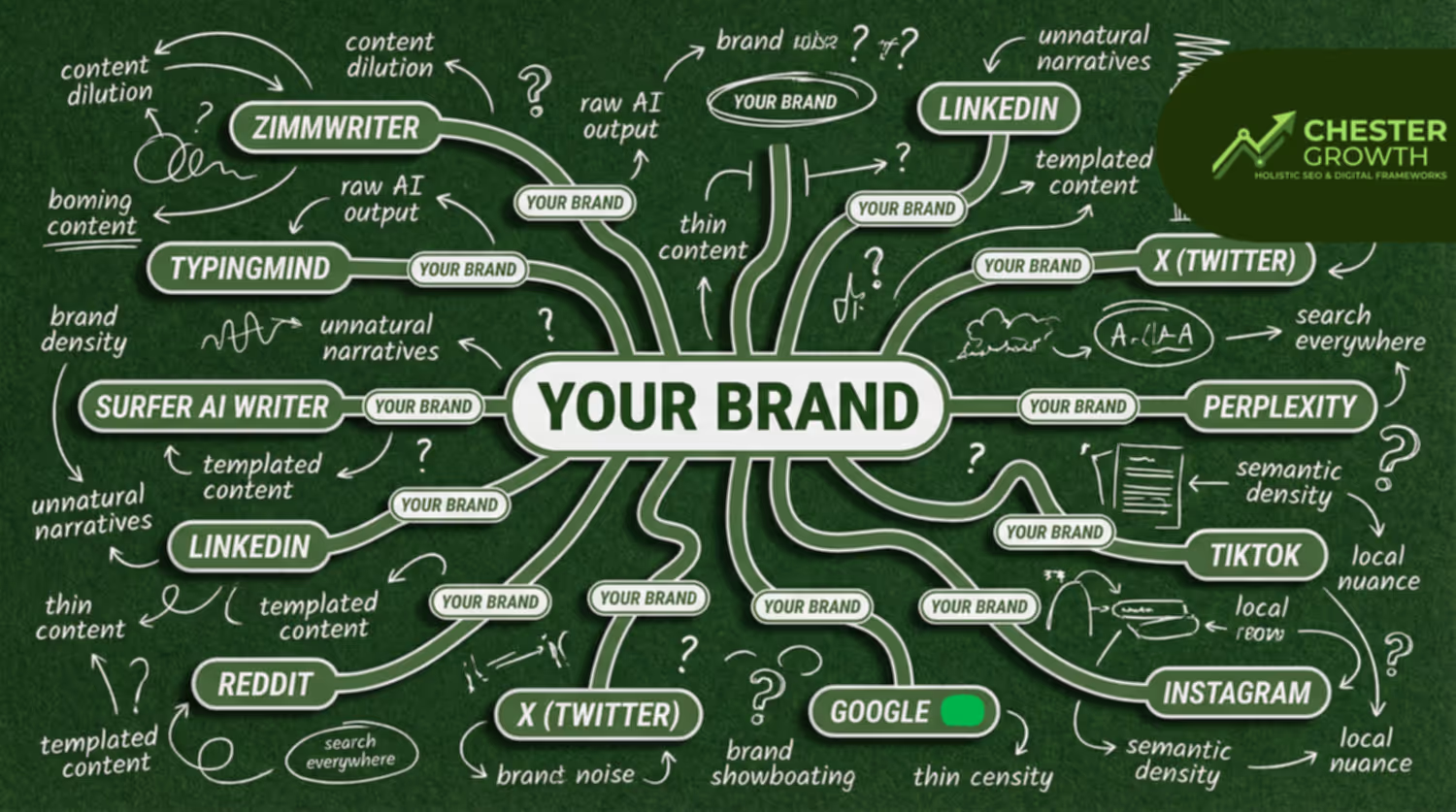
If you are optimizing for LLM visibility (ChatGPT, Perplexity), prioritize semantic density over keyword volume. As proven by Nick Eubanks' experiments, even sites with zero backlinks can be cited as primary sources if their content is semantically comprehensive. AI models retrieve 'answers,' not just 'links'. Structure your content to be the single best answer for specific, high-value questions to win these citations.
Adopt a 'Search Everywhere Optimization' (SEO) mindset. Google is no longer the sole search surface; platforms like TikTok, Instagram, LinkedIn, and various LLMs now act as powerful discovery engines. Your content strategy must extend beyond your website to optimize for visibility and citations across all relevant search environments.
The underlying principle: You must add value beyond automation. Google's AI rewards true information gain and expertise, not mere content volume.
Want to Execute This Yourself?
Get the Architect's Blueprint.
We will build your entire 3-month Semantic Strategy: keyword map, content briefs, and technical schema plan, for a one-time fee of £900.
The Deal:
You do the writing. You do the coding. We give you the precise SEO framework to ensure you don't waste a single hour.
Is 'More Content' Actually Hurting Your Rankings?
Posting weekly blogs or generating bulk AI pages often dilutes your authority. Many businesses create "weak content" that targets nothing. If your content doesn't connect to a core service entity, it's just digital noise.
Generic blogs fail to drive leads because they lack strategic alignment. Consider a London Mortgage Broker we audited: they received 17,000 national visitors per month from generic "what, why, how much" queries, yet generated less than £100 in local revenue, and they spent £4,000 a month on content. Their content wasn't bad; it was detached from local, commercial intent. It created a "flat" site structure that confuses Google about what you actually do, resulting in wasted effort and minimal real visibility.
"Random activity creates noise, whereas architectural structuring creates signal."
How Do We Build a Network of Answers that Converts?
We advocate for a "Smarter System." Instead of random posts, we build a structured grid of 30 interconnected pages. Each one answers a specific high-value buyer question.
This framework aligns content with algorithmic intent. We build "Core 30" pages, Category Hubs, and Service Vectors, creating a "web of trust" that signals expertise and depth to Google, forcing rankings for high-value commercial queries.
"Strategic lattices concentrate authority, whereas weekly blogs disperse it."
What is Brand Noise?
Brand Noise (also known as Brand Mentions) is the strategic network of interconnected mentions across multiple platforms (your website, Google Business Profile, industry directories, Reddit discussions, social media, news sites) that work together to build brand awareness and construct your Google Knowledge Graph (Google's database of entities and their relationships). This interconnected presence helps SEO by validating your entity and strengthening your association with specific search queries.
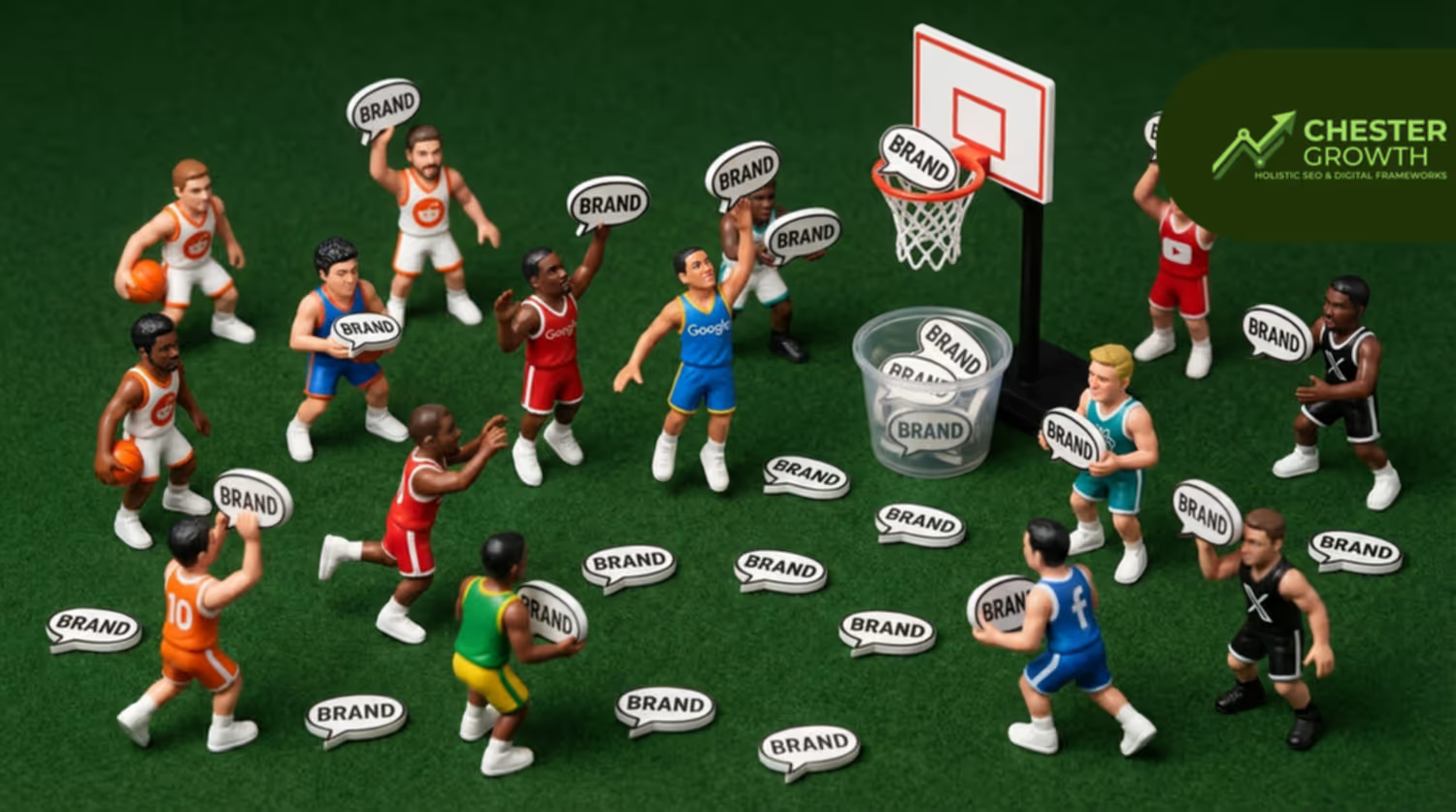
The Google Knowledge Graph functions as Google's internal encyclopedia, connecting your business name to your services, location, expertise, and reputation signals. Think of it as a web of verified facts about your business. When someone searches "divorce solicitor Chester," Google uses its Knowledge Graph to understand which businesses are legitimate experts versus generic noise.
Each authentic mention across platforms creates a signal that validates your entity. When these signals are consistent and interconnected (your Google Business Profile links to your website, your website references local entities like Chester Civil Justice Centre, Reddit users organically recommend you as a trusted resource), Google's Knowledge Graph strengthens your entity association with specific search queries. This interconnected brand noise transforms into structured authority that Google rewards with rankings.
Chester Growth invented the term "Brand Noise" to describe our specific methodology that goes beyond traditional brand mentions. While brand mentions refer to any instance where your business name appears online, Brand Noise is the strategic orchestration of interconnected mentions across platforms that are deliberately engineered to construct Google Knowledge Graph associations.
How we do it: We create a network of entity-validated mentions where each platform reference reinforces the others. Your website links to your Google Business Profile, your GBP posts reference local entities (Chester Civil Justice Centre, neighborhood names), your Reddit participation organically mentions your expertise, and industry directories cite consistent NAP (Name, Address, Phone) data. These mentions are not random; they are architecturally designed to signal authority.
Why we do it: Google's algorithm does not just count mentions; it evaluates their consistency, interconnection, and contextual relevance. Brand Noise creates a "signal web" that tells Google exactly what you do, where you operate, and why you are the authoritative answer for specific search queries. This transforms scattered brand mentions into structured, rankable authority.
Yes, but it requires strategic reputation repair, not just adding more mentions. If your brand noise carries negative sentiment (bad reviews, complaint forums, negative press), simply increasing mention volume will amplify the negative signals. Google's sentiment analysis detects reputation patterns across platforms.
The fix: First, address the root cause (fix service issues, resolve customer complaints). Second, generate authentic positive signals that outweigh negative ones. This means earning genuine positive reviews on Google Business Profile, getting verified client testimonials on your website, participating helpfully in Reddit discussions where users organically recommend you, and securing positive coverage in local news or industry publications.
Why it works: Google's Knowledge Graph weights recent, consistent signals more heavily than old noise. By systematically building positive, interconnected mentions (your satisfied clients mention you on Reddit, your case studies reference real outcomes, your GBP posts demonstrate expertise), you create a new dominant signal pattern that pushes negative noise into the background. The key is authenticity: fake reviews or paid mentions will be detected and penalized, making the reputation problem worse.
Struggling with Negative Brand Noise?
We Can Fix It.
We do not typically offer standalone reputation repair, but if your business is in real trouble with negative reviews, complaint forums, or damaging press, we can rebuild your brand noise in one month for a one-off fee of £3,000. This includes strategic reputation management, authentic positive signal generation, and Knowledge Graph reconstruction.
Why Are Your Competitors Outranking You With Smaller Sites?
Because Google ranks 'pages,' not 'websites.' If you list 10 services on a single homepage, you dilute your relevance for all of them. Competitors win because they build dedicated, authoritative pages for each specific service, signaling deep expertise to the algorithm. Here is the specific error holding back your sector.
Grouping "Divorce, Wills, and Litigation" onto a single "Services" page. Google cannot rank one URL for ten disparate topics. You need dedicated, deep pages for each legal area to compete.
Publishing a gallery of beautiful images with zero text. Google is text-based; it cannot "see" your design. Without descriptive case studies, you rank for nothing but your brand name.
Relying entirely on Rightmove links. This builds their SEO, not yours. You need local "Area Guides" (e.g., "Living in Hoole") to capture buyers early in their search journey.
Listing "Extensions, New Builds, Renovations" as simple bullets on a homepage. Each service needs a dedicated landing page (e.g., "House Extensions Chester") to rank for that specific intent.
Describing features ("Audit Services") instead of solving problems ("Tax Investigation Help"). Clients search for solutions to pain points, not technical industry terms.
Recognize These Costly Errors?
Get the Blueprint to Fix Them.
Recognize these costly mistakes? Stop building 'flat' sites and start engineering authority. Our £900 Blueprint provides the exact architectural drawings to fix your structure and dominate local search.
We Speak Human. And We Speak Google.
Your competitors often have static websites; we build dynamic semantic data entities. This means Google doesn't just read your content; it understands your business's core identity: its precise name, verified services (like 'Commercial Litigation'), geographic footprint in Chester, and authenticated client reviews.
By explicitly defining these specific details and their relationships through structured data, the hidden code language that search engines speak, we feed Google's Knowledge Graph (its global database of verified facts) directly. This transforms your online presence from mere text into intelligent, machine-readable data that truly ranks.
Chester Family Law Specialists
Premier Legal Services
What Does a Hyper-Targeted SEO Strategy Look Like?
A hyper-targeted SEO strategy requires a network of interconnected pages, typically around 30, that answer specific buyer questions instead of covering broad, generic topics. The exact number of pages may vary based on the topic, location, business type, competition, and search volume.
Each page targets exact-match searches (e.g. "conveyancing solicitor Chester prices") and links to related services to distribute authority across your site. This improves the correlation between the pages and allows Google to see their contextual relevance and topical relationship. This framework replaces scattered blog content with a precise structure, where every page supports commercial intent and connects to Chester locations, landmarks, and buyer concerns.
Core Topic Node.
High-Intent Leaf.
Equity Flow.
Local Anchor.
Protocol SEO Framework
Categories organize your expertise. We build dedicated topic areas to show Google you cover every aspect of your service completely.
Detailed service pages capture ready-to-buy searches. We create pages for exact services your ideal clients are actively searching for.
Internal links guide visitors through your site. We connect general topic pages to specific service pages, helping both users and Google understand your expertise.
Geographic content proves you serve specific areas. We mention exact Chester locations and landmarks to rank for local searches.
Injection fixes gaps. We deploy targeted assets to bolster specific areas where current performance lags.
How Can Businesses Engineer Their Own Local Semantic Graph?
Adopt Chester Growth's fundamental hyper-targeted SEO framework by structuring your website into topical sections rather than scattered pages. Build service-focused landing pages that answer specific client questions instead of vague "about us" statements.
Establish navigational pathways between related content rather than isolated silos. Embed geographic markers and Chester landmarks throughout your copy instead of generic "local business" claims. Address knowledge gaps with targeted resources rather than duplicate promotional material.
Divide your site into clear sections by what you offer, not by company history. For example: Service providers create 'Commercial Services' and 'Residential Services' sections. Retailers organize by product categories. B2B firms separate 'Solutions' from 'Industries Served.' This helps search engines understand your business model.
Create pages for exact services customers search for with location modifiers. Examples: 'Emergency Plumbing Chester,' 'Commercial Cleaning Hoole,' 'IT Support Chester Business Park.' Include your service process, response times, and coverage areas. Avoid generic 'Services' pages that list everything.
Link general information to specific solutions. For example: Link your 'Why Choose Us' page to individual service pages. Connect blog posts about problems to pages offering solutions. Link area guides to relevant services. This creates pathways for both visitors and search engines to explore your expertise.
Mention specific neighborhoods, streets, and landmarks throughout your content. Examples: 'Serving businesses near Chester Station,' 'Commercial clients in Chester Business Park,' 'Residential customers in Hoole and Handbridge.' Reference local councils, courts, industrial estates, or shopping districts relevant to your sector.
Identify questions prospects ask before hiring you, then create dedicated pages answering them. Examples: 'Pricing Breakdown,' 'Service Guarantee Terms,' 'Response Time Policy,' 'Coverage Area Map.' Address objections and concerns directly rather than repeating sales messages.
Prioritize the 'BLUF' rule: Bottom Line Up Front. Answer the user's core question immediately. Then, predict their next step (e.g., pricing -> timeline) to keep them on your site.
Yes. AI looks for 'Visual E-E-A-T'. Replace stock photos with real project images to signal authenticity. Broken layouts or 'ugly' design degrade the trust score LLMs assign to your brand.
Freshness is a ranking factor for AI. Audit content older than 4 months. If facts, prices, or market conditions have changed, update it immediately to stay in the 'active' knowledge graph.
How Does Google Rank "Near Me" Searches in Chester?
Google geolocates the user, surfaces the map pack with Google Business Profiles, then lists organic pages. Chester Growth optimizes your GBP and builds 30 interconnected pages targeting exact Chester searches (like "solicitor Chester prices"). This structure embeds location entities, landmarks, and service specifics throughout your site, so Google matches you to "near me" queries without requiring those exact words on every page.
- Geolocates the searcher to define "near me".
- Shows the map pack first with 3-5 GBPs.
- Links each pack result to its GBP details.
- Lists organic pages below the pack.
- Fully complete GBP with precise categories, hours, services, and Chester-specific Q&A.
- Point each GBP to a tailored landing page per category or location, with map embeds.
- Use AI-assisted prompts to strengthen GBP copy and Q&A, then mirror it on-site.
- Keep NAP data consistent across directories to reinforce trust and citation strength.
- Category pages for every major service tied to Chester neighborhoods and landmarks.
- Service pages layered with geo signals and FAQs that answer "best [service] near me?".
- Internal links that route equity between hubs and service leaves plus GBP landing pages.
- AI + GBP precision: reuse on-site language in GBP descriptions to align signals.
What is the key factor to rank in local SEO?
The most important factor is precise relevance, especially the primary category in your Google Business Profile and how closely your website content, services, and local signals match the search intent. Avoid using broad categories.
Tip: Choose the primary category that directly matches what you want to rank for.
Example: To rank for "personal injury solicitor," set the category to Personal Injury Solicitor, not Law Firm. A broad category weakens relevance and reduces your chance of ranking for specific queries.
- Set the Google Business Profile primary category to the most specific match for your target query.
- Align homepage headings, service pages, and meta data with that specific service.
- Use consistent citations, local schema, and a profile description that mention the exact service.
- Request reviews that reference the specific service (e.g., "personal injury").
- Create local content and build links that target the specific search intent, not the broader industry.
What is the wrong way to set up the primary category?
Choosing a broad or generic primary category (e.g., "X Service Contractor," "Law Firm," or "Home Services") is ineffective. It dilutes relevance for specific searches. Google treats the primary category as a strong signal of intent. A generic category causes your profile to compete across unrelated searches instead of ranking for the service you want.
- • Lowers relevance for narrow, high-intent queries
- • Attracts mismatched traffic with low conversion potential
- • Makes it harder for Google to align your business with user intent
- • Select the most specific category that directly matches the service you want to rank for (e.g., "X Repair Service," "Personal Injury Solicitor," or "Roof Leak Repair")
- • Use broader categories only as secondary options
- • Match page headings, service lists, citations, and reviews to that specific service
- Audit your current primary category and replace it if it's generic
- Set the most specific relevant primary category in GBP
- Use secondary categories only when they reflect actual services
- Update H1/H2 tags, meta descriptions, and service lists to match the specific category
- Ask for reviews that include the exact service term
- Ensure schema, citations, and Google Posts reference the specific service
- • Don't change categories frequently. Time changes with campaigns or seasonal shifts
- • Don't rely on page content alone. The primary category must match the intended service
- • Avoid made-up categories. Select the closest official Google option
Should you change your Google Business Profile (GBP) primary category every season?
Yes, but only as a strategic decision. Changing your primary category seasonally can improve relevance for seasonal search intent (e.g., switching to Snow Removal Service in winter). Make changes cautiously to avoid unnecessary ranking disruption.
- • The primary category is a strong relevance signal. A specific seasonal category increases your chances of appearing for seasonal searches.
- • Improves alignment between search intent, your profile, website, and local signals, leading to higher click-through and conversion rates.
- • Timing: 2-4 weeks before the season starts. This gives Google time to reprocess the change.
- • Duration: Keep the seasonal category active for the entire season or campaign. Revert only if performance drops.
- • Frequency: At most, once per season. Avoid frequent back-and-forth changes.
- Select the most specific seasonal category (not a broad parent category).
- Update your landing page and headings (H1/H2) to reflect the seasonal service.
- Change the GBP primary category to the seasonal one. Keep the core category as a secondary if possible.
- Post an update in GBP and include seasonal photos, pricing, or offers.
- Update schema markup, service lists, and citations. If you don't know what schema is, use ChatGPT with this prompt: "Create LocalBusiness schema markup for [your business name] in Chester offering [your seasonal service]."
- Monitor results for 2-6 weeks. Revert if performance declines.
- Impressions and search terms in GBP Insights
- Rankings for seasonal keywords
- Clicks, calls, directions, and conversions
- Compare metrics to a 30-60 day baseline
- → Short-term volatility: Change categories before the season starts and retain your core service as a secondary category.
- → Loss of long-term signals: Keep website content optimised for the main year-round service. Use seasonal landing pages to support the temporary change.
Landscaper: Change to Snow Removal Service in winter; keep Landscaping as secondary.
Heating Engineer: Use Boiler Repair in winter, switch back to Heating Engineer in off-season.
Law Firm: Avoid switching from a specific category like Personal Injury Solicitor to a broad one like Law Firm if your goal is to rank for that specific area.
- Select seasonal primary category
- Update landing page content and metadata (due: 3 weeks before season)
- Change GBP primary and add secondary
- Publish GBP post with seasonal photos or offers
- Track 30/60-day KPIs and decide to keep, revert, or adjust
Should you use the Google Business Profile "Products" section for services?
Yes. Although the Products section is often intended for physical items, using it for services is highly effective. It increases relevance, highlights specific offerings, and can improve local rankings and conversions when done correctly.
- Adds searchable service signals (titles and descriptions) directly to your GBP
- Provides keyword-bearing entries that align with search queries
- Improves user experience with visible CTAs and service links
- Allows seasonal or promotional callouts without changing the primary category
- Drives traffic and conversions through targeted landing page links
- Create one product entry per core service using the exact service name you want to rank for
- Use clear, keyword-matching titles (e.g., "Boiler Repair Service - Emergency")
- Write concise descriptions that include benefits, local references, and a single CTA. Avoid keyword stuffing
- Add a high-quality, relevant image (e.g., before/after, technician at work)
- Link to a dedicated landing page with matching H1, schema, and UTM tracking
- Add optional pricing or "From" text if relevant, and mark seasonality/availability
- Group similar services into product categories to keep the profile organised
- Add seasonal or promo-based entries as needed instead of altering your primary category
- • Match product titles closely to your on-site service names
- • Use landing pages with local terms, schema markup, and embedded reviews
- • Track product traffic and conversions with UTM parameters
- • Add or rotate seasonal entries 2-4 weeks before peak demand
- • Avoid duplicating near-identical entries. Focus on unique, high-value services
- • Keep descriptions focused on user value, not just keywords
Core Service: "Emergency Drain Cleaning"
- Product Title: Emergency Drain Cleaning - 24/7
- Description: Fast service in Chester, same-day response.
- Link: Dedicated landing page with CTA, schema, and reviews
Seasonal: "Snow Removal Service"
- Add as a product during winter months
- Link to seasonal landing page with pricing and service area
- • Don't keyword-stuff titles or create too many similar product entries
- • Don't rely on Products alone. Support with matching content, schema, citations, and reviews
- • Keep all product info current. Outdated pricing or services reduce trust and engagement
- Identify exact service names to feature (who: SEO/owner)
- Create GBP product entries with title, image, description, CTA, and UTM link (who: GBP manager/web - due: 1 week)
- Build or align landing pages with schema and reviews (who: web/SEO - due: 2 weeks)
- Add seasonal product listings 2-4 weeks before peak (who: marketing)
- Track GBP Insights and UTM conversion data for 30-60 days and adjust (who: analyst)
How to See Better Chester Ranking Results in Weeks, Not Months?
To improve rankings, you may have used AI tools like ChatGPT 5, Claude 4.5, or Claude Opus 4.5, along with SEO platforms such as Surfer SEO, WriterZen, or ZimmWriter to create service pages, blog posts, and FAQs. These pages often rank briefly before dropping off, generating little to no clicks or impressions.
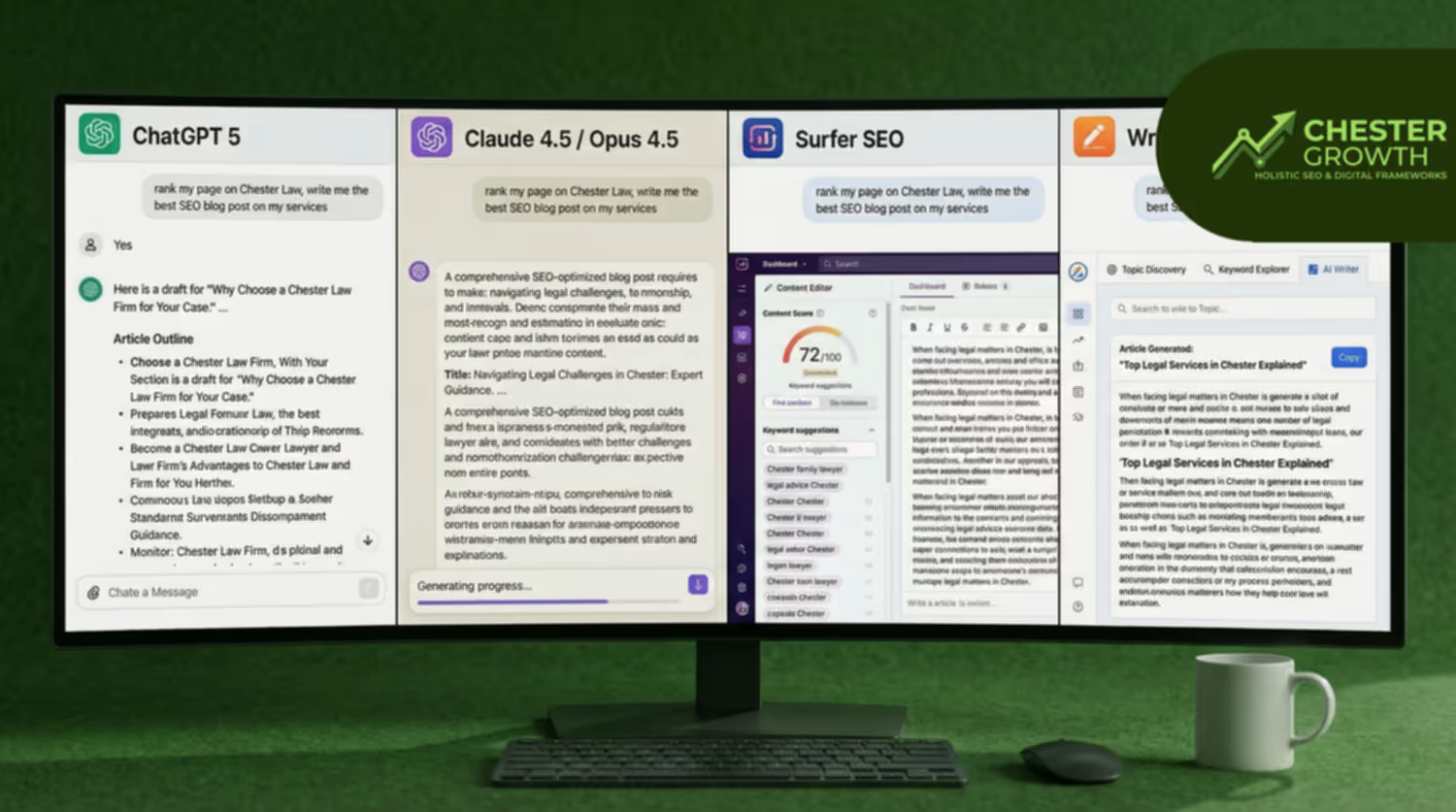
To achieve better and longer-lasting rankings and to appear in search results within weeks or even days, your site structure plays a crucial role. For faster, more stable results, use our local business website content prompt (below) to generate high-quality content in hours instead of weeks. Then, build a network of 30 interconnected pages to support commercial intent and improve visibility.
For example, if you are a solicitor in Chester, you can create category hubs like "Family Law in Chester" (your main practice area page) and then build specific service pages under it like "Divorce Solicitor Chester," "Child Custody Solicitor Chester," and "Prenuptial Agreement Solicitor Chester."
Within each page, naturally mention Chester neighborhoods (Hoole, Handbridge, Upton) and local landmarks (Chester Cathedral, Grosvenor Park) in your paragraphs where relevant to your service area.
Include verified client reviews which you can prove by taking a screenshot from your Google Business Profile or linking directly to it. You can also add the actual review text and mention what exactly you did for that client. The reviews must be relevant to the specific page where you are posting them. For example, on your "Divorce Solicitor Chester" page, only include reviews from divorce clients, not from clients who used your services for property conveyancing or personal injury cases.
- Use AI to draft conversion-first copy aligned to Chester search intent.
- Answer real, spoken questions to satisfy Google and AI systems.
- Iterate fast: generate, refine, and ship within days, not months.
- Export these bullets into your LLM to produce ready-to-edit drafts.
- Rebuild into category and service pages instead of blogs.
- Embed local signals (neighborhoods, landmarks, service areas).
- Link hubs to service leaves to pass authority efficiently.
- Feed this structure to your LLM so every page inherits Chester geo context.
- Optimize GBP landing pages for each category/location.
- Keep NAP consistent across every directory to boost trust.
- Use AI prompts to strengthen GBP copy and Q&A for faster lifts.
- Copy these steps into your LLM prompt to standardize GBP updates.
How Can 10 Google Reviews Outrank 900 in Chester Maps Pack?
Why do 10 Google reviews outrank 900? Google's Maps Pack algorithm prioritizes relevance, proximity, and structured website authority over raw review volume. A Chester solicitor with 10 reviews who has built 30 interconnected service pages (like "Divorce Solicitor Chester," "Child Custody Chester," "Family Law Chester") with proper internal linking, Chester neighborhood mentions (Hoole, Handbridge, Upton), and verified client testimonials will outrank a competitor with 900 generic reviews but a flat, single-page website with no local signals.

The 10 reviews are more beneficial because they are relevant to specific services and properly integrated into a structured site. For example, a divorce review on your "Divorce Solicitor Chester" page carries more weight than 100 mixed reviews (conveyancing, wills, personal injury) scattered on a generic "Services" page. The 900 reviews often fail because they lack context: Google cannot connect those reviews to specific search queries like "divorce solicitor near me" when the website structure does not support it with dedicated service pages, internal links between related topics, and local geographic anchors.
- Align GBP categories and copy to the exact service + Chester location.
- Match on-page language to the specific query (e.g., "emergency plumber in Chester").
- Use question-led headings to mirror real user searches and feed this to your LLM.
- Prompt your LLM to weave landmarks and neighborhoods into every answer.
- Build Core 30: category + service pages with Chester geo signals.
- Link hubs to service leaves to concentrate topical authority and GBP alignment.
- Keep NAP and citations consistent to reinforce trust for every query.
- Give this structure to your LLM so outputs stay aligned to Chester signals.
- Craft GBP descriptions and Q&A with AI for clarity, intent, and citations.
- Use exact-match services and Chester locations in GBP attributes and posts.
- Pair GBP landing pages with on-site service pages for the same intent and link them.
- Copy these steps into your LLM prompt to standardize GBP and citation updates.
Do businesses with many reviews have a higher chance of ranking better?
Not directly. While reviews help with trust, relevance, and click-through rates, they are not the only factor. Google considers reviews alongside core local ranking signals such as proximity, category relevance, on-site content, structured data, backlinks, and GBP configuration. Reviews alone won't drive rankings without supporting signals.
- • Trust & CTR: More positive reviews can increase clicks and conversions from the Local Pack
- • Content signals: Review text that includes service names or locations can boost relevance
- • Freshness: Recent reviews signal ongoing activity
- • Competitive edge: Reviews help more when competitors have similar technical and local profiles
- • Proximity and primary category relevance often outweigh review count
- • Google requires a clear match between your GBP, category, and landing page content
- • Structured data, citations, backlinks, and relevant on-page content are also essential
- • Set a specific and accurate GBP primary category (who: GBP owner)
- • Link your GBP to the most relevant service page, not always the homepage (who: GBP owner/web)
- • Create or optimise landing pages with matching H1/H2 tags, local schema, location terms, and embedded reviews (who: web/SEO)
- • Ask for reviews that mention specific services and city/area names (who: customer operations)
- • Respond to reviews professionally and in a timely manner (who: customer operations)
- • Maintain consistent NAP (Name, Address, Phone) data across all key directories (who: listings manager)
- • Build local and niche-relevant backlinks to the service page (who: outreach)
- • Use the GBP Products and Services sections to list key offerings (who: marketing)
- • Track performance using GBP Insights, organic rankings, and UTM data (who: analyst)
Focus on getting high-quality, relevant, and recent reviews. But to rank locally, your GBP and website content must align precisely with the service and location you're targeting.
What to do if you get instant bad reviews from scammers?
Do not reply publicly. Responding can increase visibility and make the review appear legitimate. This is a scam that's been ongoing since 2022. Google has taken action to address this issue. Here's what to do:
- • Take a screenshot
- • Record the date and time
- • Note the reviewer's name and profile link
- • Gather any evidence that shows the review is fake or malicious
In Google Business Profile:
Go to Reviews, find the review, click the three-dot menu, select Flag as inappropriate
In Google Maps:
Open the review, click the three-dot menu, select Report review
- • Use Google's review reporting form
- • Or contact Google Business Profile support via the Support option in your dashboard
- • Provide evidence and clearly explain how the review breaks Google's policies (e.g. spam, fake content, impersonation)
Google's team may take several days or weeks to assess and respond
- • Use GBP chat or phone support for direct assistance
- • Contact Google Business Profile support via Twitter/X if response is delayed
- • For reviews that are defamatory or breach UK law, consider submitting a legal removal request
- Ask recent genuine customers to leave new reviews (focus on quality and relevance to location or service)
- Set up notifications to monitor for new reviews
- If multiple fake reviews come from the same source, collect and submit that evidence during escalation
- • Respond calmly and professionally
- • Offer to resolve the issue privately (email or phone)
- • Do this only when the feedback is real. Do not respond to known scams
Should all your reviews be on Google Business Profile?
No, but Google should be your main focus. Aim to follow an 80/20 split: target 80% of your reviews on Google Business Profile (GBP), and 20% across other trusted platforms such as Facebook, Yelp, industry directories, or Trustpilot.
GBP drives the most local SEO value, but spreading reviews improves trust, visibility, and protection against platform issues.
Choose based on where your audience is active or where trust is highest in your field:
- • Yelp
- • Trustpilot or Feefo
- • Industry-specific directories (e.g. legal, trades, healthcare)
- • Sector-specific review sites or aggregators
- Ask after a positive service interaction or successful job
- Provide a direct review link with simple instructions
- Encourage them to mention specific services and location
- Avoid offering incentives. Google and other platforms prohibit this
- Follow up once only. Don't pressure the customer
Email or SMS (Google focus):
"Thanks for choosing [Business]. If you're happy with our [service], could you leave a quick Google review here: [link]? Mention the service and area, it helps others find us."
In person or on receipt:
"Great working with you. A quick review on Google or Facebook would mean a lot. Scan this QR to leave feedback."
Follow-up for another platform:
"If you liked our work, please share your experience on [platform name]. Your feedback helps others in the local area."
- → Default channel: Send most customers to Google
- → Alternative channels: Direct some customers to other platforms based on service type or interaction
- → Automated email flows: Use light logic to split requests (e.g. retail → Facebook, B2B → LinkedIn)
- Display selected reviews on your website with clear source attribution
- Use Review Schema markup for better visibility in search
- Create deep links and QR codes for each review platform
- Track review volume and sentiment by platform to adjust your strategy
- • Don't reply emotionally. Respond professionally if the review is valid
- • Report fake reviews to the relevant platform with evidence
- • Encourage satisfied customers to leave new reviews to balance the profile
- Create direct review links and QR codes for Google and 2-3 other platforms (owner/ops, due in 1 week)
- Set up post-service email/SMS requests with platform split (marketing, 1-2 weeks)
- Train staff to ask for reviews with the right links (customer ops, immediate)
- Add review snippets with schema to high-traffic pages (web/SEO, 2-4 weeks)
- Monitor review trends and adjust the platform split as needed (analyst, ongoing)
Keep Google Business Profile as your review priority for local SEO. But place around 20% of your reviews on other trusted platforms to build brand resilience, improve visibility, and protect against review manipulation.
How often is best to publish on Google Business Profile?
Post as consistently as possible. Steady, ongoing updates perform better than occasional bursts. Google values recent, active content when assessing local visibility.
-
2-4
GBP posts (Updates/Offers): 2 to 4 times per week
Posts typically remain visible for 7 days. Weekly posting is the minimum
-
3-7
Photos: 3 to 7 new images per week
Before/after, job in progress, team shots
-
1-4
Short videos: 1 to 4 per month
30-60 seconds of project footage or client feedback
-
📅
Products/Services entries: Update monthly or per campaign
-
🎯
Seasonal/offers: Post 2 to 4 weeks before launch
- Signals relevance and activity to Google and users
- Frequent content builds trust and encourages clicks
- Recency helps you appear in local results more often
- • Project of the day: 1-2 photos, short caption, CTA to service page
- • Before/after: Simple visual proof of recent work
- • Customer testimonial: Quote image or short video clip
- • Seasonal promo: Service highlight or time-limited offer
- • Team or behind the scenes: Helps humanise the brand
Project post:
"Today's project: [Service] in [Neighbourhood]. Quick turnaround. Photos below. Book now: [landing page URL with UTM]"
Review request:
"Thanks, [First Name]. If we helped, a 1-minute Google review would mean a lot: [short link]"
- Plan and schedule 1-2 posts per week in advance
- Batch upload 5-10 photos weekly for easier management
-
Use a simple calendar:
- Mon: project post
- Wed: photo gallery
- Fri: testimonial or offer
- Schedule posts during local business hours or just before peak searches
- → Impressions, queries, and clicks in GBP Insights
- → Click-throughs to landing pages (use UTM tracking)
- → Calls and bookings from GBP links
- → Photo view count and user engagement
- Build a weekly content calendar (owner: marketing, due weekly)
- Batch photo uploads weekly (owner: ops/web, ongoing)
- Add UTM parameters to all GBP links (owner: web/analyst, ongoing)
- Review GBP Insights weekly to adjust schedule or content (owner: analyst, ongoing)
- • Avoid keyword-stuffing. Write for users, not algorithms
- • Don't repost identical content across platforms without editing
- • Don't post only offers. Include social proof and day-to-day content
It still helps. Even without a link, brand mentions support your local presence. They count as entity signals and can strengthen your business's credibility in Google's knowledge graph.
How to make the most of an unlinked mention:
- • Save a screenshot and copy the article URL with author and date
- • Contact the publisher and ask for a link. Keep the request polite
- • Add the article to your website (e.g. a "Press" or "Media" page)
- • Link to that article from a GBP post
- • Share the article on social media and tag the publisher
- • Use the feature as part of outreach to gain further local links
Can you ask ChatGPT to give you keywords?
Yes, you can, but treat the results as a starting point only. Language models like ChatGPT don't have access to real-time search data. They can suggest outdated or low-value keywords, which can dilute your SEO performance if used without validation.
- Quick generation of keyword ideas and semantic variations
- Helpful for brainstorming long-tail queries, FAQs, and topic clusters
- Can support early-stage planning for content or landing page strategy
- No access to current ranking, search volume, or competition data
- May suggest broad, low-intent, or obsolete keywords
- Cannot replace tools that show real user behaviour or live SERP results
Ask for 50 to 100 keyword ideas grouped by search intent:
- • Informational
- • Commercial
- • Transactional
- • Navigational
Include local modifiers such as:
- • [City name]
- • Neighbourhoods
- • "Near me" variants
Organise the ideas into topic clusters and map them to appropriate pages:
- • Homepage
- • Service page
- • Blog
- • FAQ
Use tools like:
- • Google Keyword Planner
- • Google Search Console
- • Ahrefs / SEMrush / Moz
- • Google Trends
Check for:
- • Monthly search volume
- • Trend stability or growth
- • Cost-per-click (CPC)
- • Keyword difficulty
For local SEO, also check:
- • GBP Insights
- • Manual or grid-based SERP results for your area
Focus first on high-intent, achievable keywords such as:
- • "[Service] in [City]"
- • "Emergency [Service] near me"
Avoid low-value keywords that are broad, non-local, or brand-driven.
Match keyword intent with page content:
- • Use proper H1, H2, and structured data
- • Point your GBP to the best-fitting landing page
- • Collect reviews that mention the service and location
Track:
- • Rankings
- • Impressions
- • Clicks
- • Conversions (using UTM links)
Update your keyword list monthly based on performance.
Role: You are an experienced local SEO
Input:
- Business: [Service]
- City: [City]
- Competitors: [domain1, domain2]
Output:
- 50 keyword ideas grouped by intent
- 10 local modifiers
- 5 FAQ-style questions
- Suggested page type for each keyword cluster
Note: Do not include generic phrases. Flag any keywords that sound like marketing language or are unlikely to be searched.
- Monthly search volume is meaningful for your niche
- Trend is stable or increasing
- Local SERP shows relevant results
- Intent of the keyword matches the landing page
- No cannibalisation of existing high-performing pages
- Keywords that don't appear in "People Also Ask" or "Related Searches"
- No search volume or declining trend for over 12 months
- Generic terms dominated by national brands
- Phrases not used by real customers
- Use ChatGPT only to generate initial keyword ideas
- Validate all keywords using trusted SEO tools
- Map each keyword to a unique, intent-matched page
- Monitor performance monthly and drop low performers
- Focus on quality and relevance, not just search volume
When asking ChatGPT or any language model to generate local keyword ideas, don't include "near me" as a standalone keyword. Instead, focus on real location terms that match how users search locally. Google adds "near me" contextually, it doesn't require you to use the phrase repeatedly in your content.
Use actual location modifiers like:
- • Specific cities (e.g. Glasgow, Leeds)
- • Local neighbourhoods or suburbs (e.g. Chorlton, Hackney)
- • Postal codes or service areas (if applicable)
- • Landmarks or district names (e.g. near King's Cross)
Example prompts for better local relevance:
"Emergency boiler repair in [City]"
"Personal injury solicitor [Neighbourhood]"
"Plumber [City] open now"
Avoid treating "near me" as a keyword to stuff into headings or meta tags, instead, ensure your business is well-optimised for local signals (accurate GBP, local citations, schema, and location-based page content), so Google can serve your result when someone searches for a service near them.
The 'Invisible' Expert: A Case Study.
"I didn’t plan to share this… but it might help a Partner today."
When Sarah, a Family Law Partner in Handbridge, first approached me, she wasn't talking about "Schema," "Backlinks," or "Core Updates." She simply said:
"George, I just need the phone to ring again… I am tired of waiting."
And honestly, that hit differently. Because behind every low-performing firm website is a real expert paying real overheads.
1. The Real Problem
At first glance, her website looked professional. But after talking with her, the disconnect was clear:
- She was invisible for "Chester" specific searches.
- National lead-gen sites (e.g., LegalZoom, LawDepot) were outranking her.
- She relied entirely on referrals (which had slowed down).
- Her "Services" page was just a bulleted list of "Divorce, Wills, Probate."
She asked me: "I win cases. I protect my clients. Isn't that enough?" Most experts feel this way. It’s not your fault SEO wasn't designed for lawyers.
2. What I Found (The Shock)
She wasn't losing clients because she was a bad lawyer. She was losing them because Google didn't trust her entity yet.
- Zero Local Signals: Her site didn't mention where she practiced, only what she practiced.
- The "Ghost" Profile: No recent Google Business Profile posts. To Google, the lights were off.
- Thin Content: Her "Divorce" page was 200 words of legal jargon. It answered zero client anxieties.
3. The Strategy: The Semantic Pivot
I didn't throw jargon at her. We built a plan around Solicitor Search Intent.
People don't search for "Family Law" because they are happy. They search because they are scared.
- Before: "We handle matrimonial disputes." (Cold)
- After: "Worried about your assets? We protect your future in Chester." (Empathetic)
Instead of generic keywords like `[Divorce Lawyer]`, we built an Entity-Rich Ecosystem:
- Targeted "Pensions & Divorce in Cheshire" (High Asset Intent).
- Created "Chester Civil Justice Centre" guides (Local Entity Signal).
- Wrote neighborhood-specific content for Hoole & Curzon Park (High Value Zones).
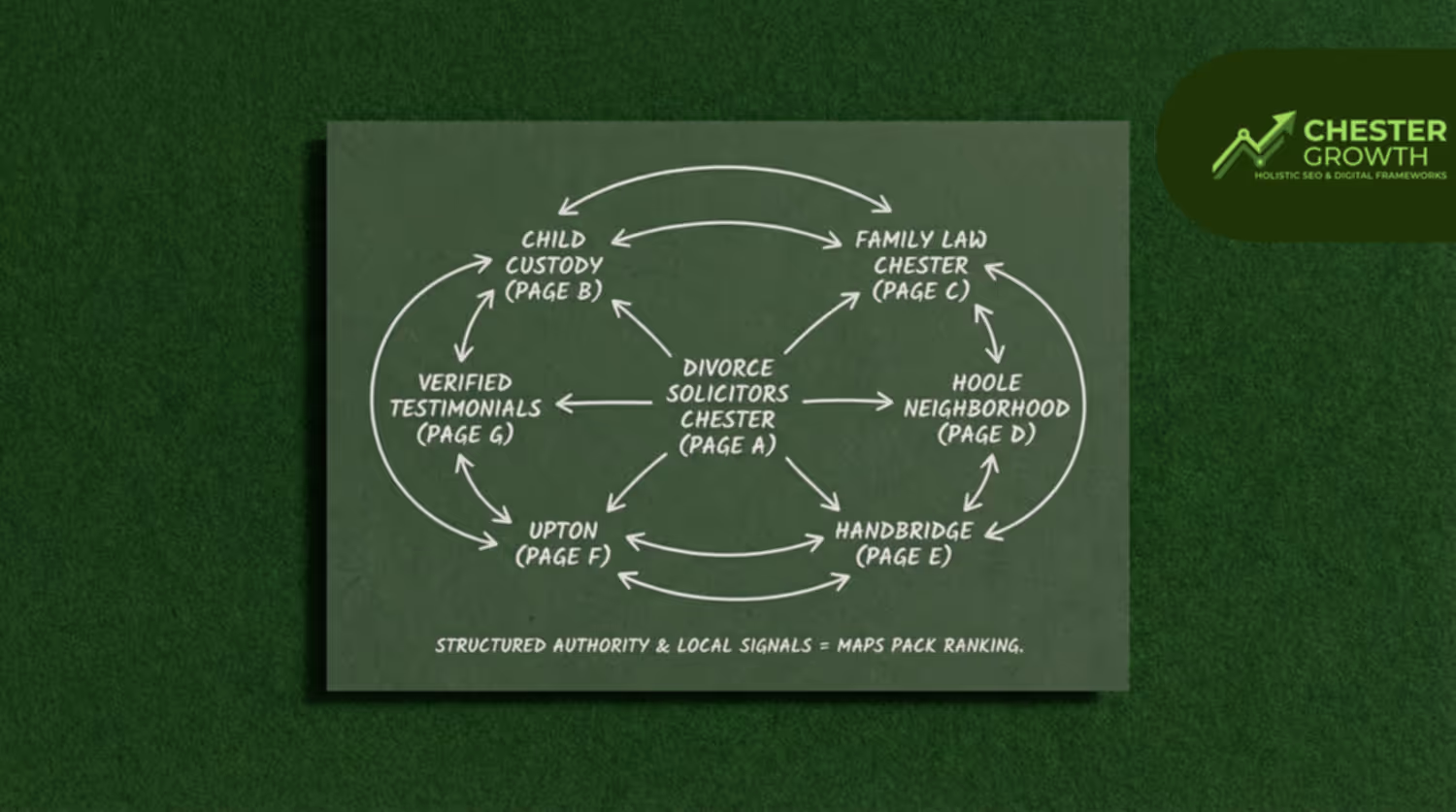
She treated her Google Profile like a static directory. We turned it into a news feed.
- Consistent GBP Posts: Implementing a schedule of 3 weekly, high-intent Google Business Profile posts.
Example: "Navigating 'Child Arrangement Orders' in Chester: Your Rights Explained." This built behavioral trust and signaled active engagement. - Geo-Optimized Review Strategy: Automated review requests were tailored to prompt clients to mention specific services and "Chester."
Example: "Sarah from Handbridge found our 'Divorce Financial Settlement' advice invaluable." This helped Google connect specific services to locations and reinforced local trust.
4. Her Results (90 Days Later)
This is where the magic happened.
- Inquiries: 12/mo → 58 qualified leads/mo.
- Map Pack: Broke into the "Top 3" for "Solicitor Chester."
- Growth: She hired a new Junior Associate to handle the caseload.
"George, this is the first time I feel seen online."
That is the real win. Not just the data. The relief.
How To Dominate in Local Search?
Use the SEO AI prompt below to generate local landing page content that targets Google Maps Pack rankings and organic search. This prompt structures content using exact-match headings, local signals, and natural language that satisfies both Google's algorithm and AI systems. Enter your target keyword, city, GBP primary category, and word count to create a custom prompt that works with ChatGPT, Claude, Gemini, Grok, and other AI tools.
Copy the sector prompt, paste it into your writing workflow or AI tool, swap in your city and service, and use the outputs to build or refine a homepage that answers those question-driven local searches. Edit the AI-generated content by adding specific facts from your company's experience: real client outcomes, exact timelines, proprietary processes. Place these details near your brand name to strengthen entity associations.
Edit these fields to personalize the prompt for your business. Changes update instantly.
Get the complete prompt engineering guide for your specific sector delivered to your inbox immediately.
What Content Strategy Works by Sector?
Each professional service sector requires a distinct content approach to dominate local search. Use these proven frameworks to build authority, capture high-intent searches, and convert Chester clients.
- Service-Specific Pages: Conveyancing, Wills & Probate, Family Law, Employment Law, Commercial Litigation
- Location Pages: Chester city center, Handbridge, Hoole, Upton, Curzon Park service areas
- Process Guides: "How long does conveyancing take in Chester?" step-by-step breakdowns
- Pricing Transparency: Fixed-fee structures, disbursement breakdowns, no-hidden-costs messaging
- "Solicitors near me Chester"
- "Conveyancing solicitors Chester prices"
- "Best family law solicitor Handbridge"
- "Employment law advice Chester"
- "Chester wills and probate fixed fee"
- Map Chester Council Terminology: Use exact terms from Chester West and Chester Council planning docs in content.
- Target Leasehold Clusters: Chester has high leasehold density in Hoole and city center. Create lease extension content.
- Answer Referral Questions: "Who does conveyancing for [local estate agent]?" positions you for agent partnerships.
- Embed Local Proof: Mention Chester FC, Grosvenor Shopping Centre, Chester Business Park in case studies.
- Fee Comparison Tables: Compare your fixed fees vs. Chester average to capture price-comparison searches.
Launch sequence for maximum local visibility:
- • Core service pages
- • GBP optimization
- • Pricing pages
- • Location landing pages
- • Process guides/FAQs
- • Review velocity push
- • Niche topic clusters
- • Local link building
- • CRO optimization
What Questions Do Business Owners Ask About Content Strategy?
Answers to the most common questions Chester business owners ask about implementing local SEO content strategies.
Should local businesses include "near me" keywords in their service page titles?
No. Google infers "near me" from your GBP, address/phone, local content, and intent. Use natural city/neighbourhood names (Chester, Hoole, Handbridge) and solid local signals instead of forcing "near me" into titles.
What if my local business doesn't have content pages for every service pillar?
Launch the highest-value service/location pages first, then add the rest. Match the top competitors' coverage over time.
How often should local businesses update their pricing and timeline content?
Refresh when your fees or turnaround shift, or at least quarterly, so users and Google/AI summaries see accurate info.
Do local businesses need separate location pages for each micro-area they serve?
Yes when demand is distinct (Hoole, Handbridge, Curzon Park); otherwise, mention areas on core pages. Avoid thin duplicate pages.
What if my local business lacks industry certifications or professional memberships?
Show your processes, guarantees, case proof, and partnerships you do have. Add certifications when earned.
How many Google reviews does a local business need to rank in local searches?
Match or beat the averages of the top 5 competitors in your sector; keep a steady flow with local detail.
What makes an effective CTA on local business service pages?
Clear next steps tied to intent: book a consult, request a valuation, get a quote, schedule a survey. Visible and repeated.
Should local businesses add LocalBusiness schema and internal links between pages?
Yes. Add LocalBusiness/Service schema and link between service/location pages to help crawlers and users.
Can local businesses use AI to generate their service and location content?
Use AI for drafts; human-edit for accuracy, tone, local proof, and conversion.
How can local businesses avoid generic content that doesn't rank in local searches?
Add local specifics (places, case outcomes), real numbers (fees, timelines), and plain language.
How Do We Write Winning Chester Sector Pages?
Full-page examples for each sector with local signals, fees, timelines, and EEAT included, ready to paste into your LLM, swap city/services, and stay aligned to both Google and AI systems.
Last year, after a tricky house sale near the Cathedral, Sarah from Boughton felt lost in all the legal paperwork. She just wanted someone clear and kind to help her understand everything. That's a common story we hear at Chester Legal. Life in our beautiful city, from Handbridge to Hoole, often brings legal questions, big or small. When you're looking for legal help, you want someone who gets it, someone who’s right here in Chester with you.
For many everyday Chester matters, hourly rates often range £180 to £300 plus VAT, with partners/specialists higher and juniors lower. Fixed fees are common for conveyancing, wills, and simple probate; more complex family or commercial work is usually hourly. We’ll be upfront about whether a fixed fee or hourly model fits your case and what the expected range looks like.
Uncontested divorces may be offered on fixed fees in the low-thousands plus court fees. Contested finances or child arrangements can run to several thousand pounds depending on complexity and speed of agreement. Many firms take an initial payment on account and bill monthly; mediation or collaborative routes can reduce total spend by significant percentages versus fully contested proceedings.
Fixed fees for straightforward freehold purchases/sales commonly sit £800 to £1,500 plus VAT and disbursements; leasehold/new-build/shared-ownership cases add supplements. Searches and Land Registry fees often add £300 to £500, so a mid-range move can total £1,500 to £2,500 before stamp duty. Remortgage fees are typically mid-hundreds plus VAT because the work is leaner.
Simple wills are often a few hundred pounds plus VAT; mirror wills or trusts cost more. Powers of attorney and IHT planning add to the total but can prevent disputes and reduce tax exposure later. Probate may be a percentage, hourly, fixed, or blended; many keep any percentage to a small single digit of estate value with clear scopes so executors can compare options.
Commercial instructions (leases, contracts, shareholder agreements) are usually hourly with upfront estimates; simple reviews may take a few hours, while larger deals can reach the mid-thousands. Personal injury often uses conditional (“no win, no fee”) arrangements where a success fee is a capped percentage of damages after costs, reducing upfront risk for workplace, road, or public-accident claims.
At Chester Legal, we’re more than just solicitors; we’re part of your community. We’re here to give honest, straightforward legal advice that makes sense for you and your family or business in Chester.
- H1 uses the target keyword conversationally: “Solicitor Chester”.
- Exact-match H2s for key services: Family Law, Divorce & Separation, Conveyancing, Wills & Probate, Business Contracts, Accident Claims.
- Local signals: Cathedral, Boughton, Handbridge, Hoole, Upton, A55.
- Story-led opening and questions that mirror real user intent.
- Clear heading hierarchy and service integration for GBP alignment.
- Google: keyword in H1/opening; exact-match service H2s; local entities; clean structure.
- AI: plain language, real questions, no filler; community knowledge baked in.
- Balanced approach: conversational lead-ins then service specifics with intent terms.
- Quality signals: helpful guidance beyond sales copy, clear services, local context.
- LLM reuse: paste, swap city/landmarks/services, keep headings and questions intact.
Imagine trying to extend your lovely Victorian home in Handbridge, only to hit a wall with planning rules, or wanting to build your dream contemporary house near Christleton, but not knowing where to start with designs. It's a common puzzle for many homeowners and businesses across Chester, from the historic Rows to the bustling new developments. You want a space that feels right, works perfectly, and fits beautifully within our unique city. That's where a local architect who truly understands Chester comes in.
Single-storey extensions or significant reconfigurations often start around £2,000 to £2,500 per m² for a good finish; premium specs can exceed £3,000 per m². A 20 m² kitchen extension in Handbridge or Hoole might sit in the £40,000 to £60,000 range before professional fees and furnishings. Full custom builds commonly run £2,200 to £2,800+ per m²; a 180 m² new-build near Christleton can reach £400,000 to £500,000 excluding land.
Architects often charge 5% to 12% of construction cost for full residential services. For a £60,000 extension that’s roughly £3,000 to £7,000; for a £400,000 custom build, £20,000 to £40,000. Typical ranges: £1,000 to £3,000 for surveys/concepts, £1,500 to £3,500 for planning drawings and submission, £3,000 to £6,000 for technical drawings on a typical extension. Full design-to-handover (tendering, contractor selection, site visits, contract admin) can mean £5,000 to £10,000+ on a single-storey extension, higher for larger builds.
Plan for local authority planning fees (often a few hundred pounds), building control fees (plan checks/inspections that can total low-thousands on small-to-medium jobs), and listed building consent costs where needed. In conservation or heritage contexts, adding 10% to 20% contingency to time and professional-fee budgets helps cover iterative discussions, revisions, and extra documentation.
Many small-to-medium residential schemes run 4 to 8 weeks for survey and concept design, 8 to 10 weeks for planning determination, 4 to 8 weeks for technical drawings and tender, and 8 to 14 weeks on site for a typical single-storey extension. Multi-storey or major reconfigurations can run 16 to 24+ weeks on site. Commercial fit-outs on the Rows or in the Business Park follow similar design phases but can add weeks for landlord/regulatory coordination.
Energy upgrades (insulation, glazing, airtightness, efficient HVAC) can add roughly 5% to 15% versus a purely cosmetic refurb. Interior design services may be fixed per room or a % of the fit-out budget; even a modest kitchen-living package can run to several thousand pounds with detailed drawings and bespoke joinery. Heritage/restoration work typically carries a premium for traditional materials, specialist trades, and conservation requirements but protects long-term value in Chester’s period buildings.
At Chester Designs, we're passionate about architecture and deeply rooted in our community. We believe good design can transform lives and businesses right here in Chester. Let us help you create a space that you'll love, perfectly tailored to our wonderful city.
- H1 includes the target keyword conversationally: “Architect Chester”.
- Query H2s with budget, fees, planning, timeline, and efficiency focus.
- Local signals: Handbridge, Christleton, Hoole, Boughton, Upton, Rows, Business Park.
- Numbers included: m² rates, project ranges, fee bands, timeframes, and contingencies.
- Clear hierarchy and service mapping to GBP secondary categories.
- Google: keyword in H1/opening; intent-led H2s; abundant local entities; semantic terms (planning, consent, fees, timelines, energy).
- AI: natural tone, real questions, local knowledge, no filler; helpful guidance over hard sell.
- Balanced copy: conversational lead-ins followed by intent-rich, numeric detail.
- Quality: practical budgeting, fees, timelines, and heritage/energy considerations for Chester projects.
- LLM reuse: paste and swap city/landmarks/numbers; retain headings and questions for intent match.
Selling your family home in Curzon Park can feel like a huge step, or maybe you're searching for that perfect rental flat near the River Dee. Perhaps you're a landlord in Hoole wondering about the best way to manage your property. Whatever your property journey in Chester, from the historic city walls to the bustling suburbs of Upton, it can sometimes feel overwhelming. You need someone who truly understands the local market, someone who’s right here in Chester, ready to help you navigate it all with ease.
Average sale prices sit around £280,000 to £320,000. Terraced homes often land in the mid-£200,000s, detached homes frequently above £450,000 depending on area and condition. Many properties spend 10 to 16 weeks on the market, but well-priced homes in Curzon Park, Handbridge, and Hoole can agree a sale faster. First-time buyers often see averages in the low-£200,000s, while home-movers pay closer to £300,000+ for larger family homes.
When it's time for Selling Homes in Chester, you want a smooth and successful experience. Whether your property is a charming terraced house in Handbridge or a modern detached home in Great Boughton, we know how to showcase its best features to attract the right buyers. We'll help with everything from accurate Property Valuations in Chester to expert marketing, ensuring your home stands out. Many people ask, "What's my house really worth in today's market?" or "How can I sell my home quickly?" We provide honest advice and a clear plan to achieve the best possible price for your property.
Typical estate agency fees range from 0.75% to 1.5% plus VAT; on a £350,000 home in Curzon Park that can mean £2,600 to £6,300 depending on the rate and marketing upgrades. Three-bed houses often sell in the low-to-mid £300,000s; four-beds can achieve over £500,000 in sought-after areas. Pricing within 2% to 5% of recent comparables can speed viewings and offers.
Navigating the rental market can be tricky for both landlords and tenants. Our Property Lettings services in Chester are designed to make it simple. For landlords, we offer comprehensive Landlord Services, including finding reliable tenants, managing tenancy agreements, and ensuring your property near the Racecourse or in Garden Quarter is well-cared for. For those Renting Properties in Chester, we help you find the ideal place to call home, guiding you through viewings and paperwork. We frequently hear, "What are my responsibilities as a landlord?" or "How do I find a good rental in Chester?" We're here to answer all your questions and provide peace of mind.
In Hoole, Upton, or near the River Dee, one- to two-bed flats often rent for £800 to £1,000 per month; popular three-beds often command £1,100 to £1,600+ depending on finish and location. That typically equates to gross yields around 4% to 6%. Letting/management fees usually run 8% to 15% of monthly rent plus VAT; tenant-find services are often 50% to 100% of first month’s rent. At £1,200/month, full management might cost £115 to £210 in exchange for marketing, referencing, maintenance, and compliance.
City averages often sit near £285,000 to £300,000 overall: flats around £180,000 to £200,000, terraces mid-£200,000s, detached £450,000+. In wider Cheshire West and Chester, averages near £260,000 to £270,000 are above the North West average but slightly below UK-wide. Key drivers: postcode, school catchments, parking, outdoor space, modern kitchens/baths, and EPC performance. Many owners review value every 12 to 24 months or before remortgaging, upsizing, or downsizing.
Getting an accurate Property Valuation in Chester is crucial, whether you're selling, remortgaging, or just curious about your asset's value. Our experienced team provides realistic and detailed valuations for properties across Chester, from the city centre to areas like Blacon and Vicars Cross. We consider all the local market factors, recent sales, and unique characteristics of your property to give you a clear picture. You might wonder, "How often should I get my property valued?" or "What affects property prices in Chester?" We give you the insights you need to make informed decisions.
Owning a rental property can be rewarding, but also demanding. Our Property Management services in Chester take the stress out of being a landlord. We handle everything from tenant inquiries and maintenance issues to rent collection and legal compliance, ensuring your investment property, perhaps in Newton or Huntington, is managed efficiently and profitably. We aim to protect your asset and keep your tenants happy, allowing you to enjoy the benefits of ownership without the day-to-day worries.
With full management, many landlords net around 3% to 5% of property value annually after fees, costs, and typical voids. Strong management reduces arrears, limits voids, and protects condition, supporting capital values. For commercial units, central Chester can achieve higher £ per square foot rents but often needs longer marketing and more complex leases. Commercial transactions can run several months from heads of terms to completion, so early planning is key.
Chester's vibrant economy relies on the right commercial spaces. Our team also assists with Commercial Property sales and lettings, connecting businesses with ideal retail units on Northgate Street, office spaces, or industrial properties in the wider Chester area. We understand the unique requirements of commercial transactions and the importance of finding a location that supports your business goals.
At George's Chester Homes (or [Your Business Name]), we're more than just an estate agent; we're part of the fabric of Chester. We’ve been helping our neighbours buy, sell, and rent properties right here for years. We believe in honest advice, local expertise, and making your property journey in our wonderful city as straightforward as possible.
- H1 uses the target keyword conversationally: “Estate Agent Chester”.
- Exact-match H2s for core services: Property Sales, Property Lettings, Property Valuations, Property Management, Commercial Property.
- Local signals: Curzon Park, River Dee, Hoole, Upton, Handbridge, Great Boughton, Racecourse, Garden Quarter, Blacon, Vicars Cross, Newton, Huntington, Northgate Street.
- Questions included: “What’s my house worth?”, “What are my responsibilities as a landlord?”, “How do I find a good rental in Chester?”.
- Clear hierarchy and service integration mapped to GBP secondary categories and services.
- Google: keyword in H1/opening; exact-match service H2s with Chester; abundant local entities; semantic terms (valuation, tenancy, landlord, remortgaging).
- AI: natural, conversational tone; answers real questions; local knowledge; avoids filler.
- Balanced: conversational hooks leading into intent-rich service detail.
- Quality: practical guidance for sellers, landlords, tenants, and commercial clients; strong local context.
- LLM reuse: paste and swap city/landmarks/services; retain headings and questions for intent alignment.
Ever driven past that old, unused plot in Saltney and pictured a brand-new, modern office building there? Or perhaps you're a homeowner in Upton, dreaming of a spacious kitchen extension, but the thought of planning and builders feels daunting. For businesses and families across Chester, from the historic heart to areas like Blacon, bringing a building project to life requires more than just bricks and mortar. You need a trusted partner, a local Construction Company Chester can rely on, to handle every detail with expertise and care.
Small domestic works like basic internal refurbishments or minor structural changes often start around £10,000 to £25,000. Single-storey rear extensions commonly fall in the £30,000 to £60,000 range depending on size and finishes. Larger two-storey extensions, full-house renovations, and bespoke new builds can reach £80,000 to £250,000 or more. Typical on-site durations: many kitchen or single-storey extensions run 8 to 14 weeks; loft conversions and multi-room refurbishments can take 10 to 20 weeks; bespoke new builds often run 8 to 12 months once ground is broken, with planning and design changes adding 20% to 30% to timelines.
For a 20 to 25 m² kitchen extension in Upton, Hoole, or Handbridge, a broad build-cost guideline is £1,800 to £2,500 per m², excluding very high-end fittings or major landscaping. Loft conversions to add a bedroom and en-suite often sit in the £30,000 to £55,000 band in wider Cheshire. Timing: many straightforward loft conversions run 6 to 10 weeks on site, while a well-planned single-storey extension might be delivered in roughly 10 to 12 weeks. Allow roughly 8% to 15% of construction cost for design, engineering, and building control fees.
For small offices, retail, or hospitality fit-outs, refurbishment packages often start around £600 to £1,200 per m², rising if specialist mechanical, electrical, ventilation, or acoustic work is needed. Ground-up commercial builds or heavily serviced spaces can exceed £2,000 per m² once shell, core, and full fit-out are included. Many businesses set a 5% to 10% contingency for straightforward refurbishments and 10% to 15% for complex or phased works. Programmes: small commercial refurbs often run 6 to 12 weeks; full reconfigurations or new-build units can span 6 to 12 months depending on size and approvals.
Older Chester properties may need structural repairs, insulation upgrades, and services renewals that add 10% to 25% to initial estimates once walls and floors are opened. Good contractors suggest at least a 10% contingency on renovations to handle unknowns. Groundworks and foundations can be roughly 10% to 20% of total cost, higher with tight access, poor ground, or drainage upgrades. Site prep (demolition, asbestos surveys or removal, temporary works) can add several thousand pounds on modest schemes and more on larger projects.
Look for membership in recognised trade bodies, full public and employers’ liability cover, and a strong local portfolio. Reputable builders often stage payments (for example, 5% to 10% on contract, then milestones for foundations, shell, first fix, second fix, practical completion) instead of large upfront sums. Request a written quotation that breaks down major cost elements and states inclusions/exclusions. Compare at least two or three like-for-like quotes, check recent local references, and confirm how health and safety, site supervision, and communication are managed.
At [Your Company Name] Construction, we're more than just builders; we're integral to the growth and development of Chester. We’ve been proudly serving our community, building homes and businesses that stand the test of time. We believe in clear communication, quality craftsmanship, and delivering outstanding construction results right here in our wonderful city.
- H1 uses the target keyword conversationally: “Construction Company Chester”.
- Exact-match H2s for core services: Residential Construction, Commercial Construction, Renovations & Extensions, Groundworks & Foundations, Project Management.
- Local signals: Saltney, Upton, Blacon, Christleton, Handbridge, Hoole, Northgate Street, Business Park, River Dee, city walls.
- Questions included: “How long does a home extension take?”, “What permits do I need for a new build in Chester?”.
- Clear hierarchy and service integration mapped to GBP secondary categories and services.
- Google: keyword in H1/opening; exact-match service H2s with Chester; abundant local entities; semantic terms (planning, permits, trades, foundations, drainage).
- AI: natural, conversational tone; answers real questions; local knowledge; avoids filler.
- Balanced: conversational hooks leading into intent-rich service detail.
- Quality: guidance on permits, timelines, and execution; strong local context for residential and commercial builds.
- LLM reuse: paste and swap city/landmarks/services; retain headings and questions for intent alignment.
Buying your first home in Saltney, or perhaps looking to remortgage your family home near the Racecourse? Maybe you're a landlord in Hoole considering a new buy-to-let property. Navigating the world of mortgages and financial decisions in Chester, from the historic city centre to the thriving suburbs of Upton, can feel like a maze. You need clear advice, a friendly face, and someone who truly understands the local property market and financial landscape. That's where a local Mortgage Broker Chester residents trust comes in.
Many brokers work fee-free or charge a flat advice fee between £400 and £500, with specialist cases sometimes up to about 1% of the loan. Lenders often pay around 0.35%-0.45% commission, so most first-time buyer or remortgage cases in Chester can be handled with little or no upfront cost. For clarity, we will outline whether we use a flat fee (for example, £395-£595) or a fee-free model paid solely by lender commission.
For a £200,000 flat in the Garden Quarter or Blacon, a 10% deposit is about £20,000; 5% products need roughly £10,000. Lenders typically want total spending (including the new mortgage) to sit below roughly 40%-45% of verified income. On a £180,000 mortgage over 30 years at ~4.5%, repayments land around £900-£950 per month, giving real numbers to answer “How much can I borrow?” in cash terms.
Many owners review 3-6 months before their fixed deal ends to avoid higher standard variable rates. With average 2- and 5-year fixes often around 4%-4.5% for strong equity cases, moving from a 7% variable on £200,000 could trim payments by £300-£400 a month and save thousands over the term. If you are releasing £20k-£50k for an extension in Great Boughton or Upton, we will show how that extra borrowing changes your monthly and total cost.
Investors in Hoole, Handbridge, and Curzon Park often target gross yields near 5%-7%. A £220,000 terrace renting at £1,050/month is roughly a 5.7% gross yield before costs. Most buy-to-let lenders want rent to cover 125%-145% of the stressed payment (often tested at 5%-7%). Broker fees for buy-to-let are commonly flat, around £400-£800, reflecting the added complexity.
Life cover for a £200k-£300k mortgage can start under £20/month for a healthy young non-smoker. Home insurance for an average Chester house often ranges £200-£400 per year, depending on value and cover. For long-term planning, many households aim to invest 10%-15% of gross income across pensions/ISAs; we will translate that into simple monthly figures alongside your mortgage and protection costs.
At George's Mortgage Solutions (or [Your Business Name]), we're more than just brokers in Chester; we're your neighbours, dedicated to helping you achieve your property and financial goals. We believe in honest, straightforward advice and building lasting relationships within our beloved city. Let us help you unlock your financial potential today.
- H1 uses the target keyword conversationally: “Mortgage Broker Chester”.
- Query H2s aligned to user intent: broker costs, deposits/payments, remortgage savings, landlord returns, protection costs.
- Local signals: Saltney, Racecourse, Hoole, Upton, Garden Quarter, Blacon, Great Boughton, Handbridge, Curzon Park, city centre, River Dee.
- Numbers included: fee ranges, deposits, monthly payments, rate ranges, yield bands, insurance costs.
- Clear hierarchy and service integration mapped to GBP secondary categories and services.
- Google: keyword in H1/opening; intent-led H2s; abundant local entities; semantic terms (deposits, eligibility, lenders, equity, premiums, income protection); concrete numbers for EEAT.
- AI: natural, conversational tone; answers real questions; local knowledge; avoids filler.
- Balanced: conversational hooks leading into intent-rich detail with actual figures.
- Quality: guidance on borrowing, refinancing, protection, planning, and landlord returns with real-world numbers.
- LLM reuse: paste and swap city/landmarks/services/figures; retain headings and questions for intent alignment.
Running your own business in Chester, whether you're a contractor working on Chester Business Park projects, a landlord managing properties in Hoole, or a startup operating from the Enterprise Centre, means dealing with tax returns, VAT, payroll, and endless deadlines. You need an accountant who speaks your language, understands local business challenges, and makes compliance simple. That's where a trusted Accountant Chester business owners rely on can help.
Most Chester accountants charge fixed monthly fees ranging from £80-£150 for sole traders, £150-£300 for limited companies, and £300-£600 for businesses with VAT and payroll. Annual accounts might cost £400-£800 for sole traders, £800-£1,500 for limited companies, depending on turnover and complexity. Transparent pricing helps you budget accurately and avoid surprise fees at year-end.
Bookkeepers record transactions, reconcile bank accounts, and manage receipts - typically charging £15-£30 per hour or £100-£250 monthly. Accountants handle tax planning, file accounts with HMRC and Companies House, advise on business structure, and ensure compliance - qualified ACCA or ICAEW chartered accountants offer strategic guidance bookkeepers cannot. Many Chester firms offer both services as packages.
Self-assessment tax returns are due 31st January (for previous April-April tax year), with balancing payments and first payment on account due the same day. VAT returns are typically quarterly, due one month and 7 days after each period ends. Limited company accounts are due 9 months after year-end at Companies House, and corporation tax is due 9 months and 1 day after year-end. Missing deadlines triggers automatic penalties starting at £100.
Limited company directors can optimize salary/dividend ratios, typically taking £9,100-£12,570 salary (below NI threshold) and dividends for remaining income, saving £1,000-£3,000+ annually in NI. Claim capital allowances on equipment purchases - Annual Investment Allowance allows 100% relief on qualifying assets up to £1 million. Register for VAT voluntarily to reclaim VAT on business purchases if beneficial. Contribute to pensions for corporation tax relief while building retirement savings.
MTD requires VAT-registered businesses (over £85,000 turnover) to keep digital records and file VAT returns through compatible software like Xero, QuickBooks, or Sage. Most Chester accountants now include MTD-compatible software setup in their packages. Penalties apply for non-compliance, but transitioning is straightforward with proper accounting software and guidance - most clients complete migration in 1-2 months.
At Chester Accounting Solutions (or [Your Practice Name]), we're more than number-crunchers; we're your local business partners who understand Chester's commercial landscape. We're here to simplify compliance, minimize your tax, and help your business thrive. Let us handle the figures so you can focus on growing your Chester business.
- H1 uses the target keyword conversationally: "Accountant Chester".
- Query H2s aligned to user intent: accountant costs, bookkeeper vs accountant, tax deadlines, tax reduction, Making Tax Digital.
- Local signals: Chester Business Park, Hoole, Enterprise Centre, Chester commercial landscape.
- Numbers included: fee ranges, deadline dates, tax savings, salary/dividend thresholds, MTD turnover limits.
- Clear hierarchy and service integration mapped to GBP secondary categories and services.
- Google: keyword in H1/opening; intent-led H2s; local entities; semantic terms (VAT, HMRC, Companies House, corporation tax, capital allowances, Self Assessment); concrete numbers for EEAT.
- AI: natural, conversational tone; answers real questions; local knowledge; avoids jargon.
- Balanced: conversational hooks leading into intent-rich compliance and tax planning detail.
- Quality: guidance on costs, deadlines, tax optimization, MTD compliance with real-world figures.
- LLM reuse: paste and swap city/landmarks/services/figures; retain headings and questions for intent alignment.
Local vs National: What Wins in Chester?
Two quick comparisons built around real Chester scenarios: picking local specialists over national agencies, and choosing an SEO-led build instead of a generic template when you need visibility and conversions.
Solicitors/Brokers: Local SEO firms understand Chester council processes, Chester Civil Justice Centre proximity, and Chester lender relationships, ranking you for "solicitor near me Chester" with authentic local signals that national agencies can't replicate.
Accountants: Local SEO targets Chester business community, Enterprise Centre startups, and Business Quarter firms, capturing "accountant Chester" searches with Making Tax Digital expertise and sector-specific knowledge (CIS, landlords, contractors).
Architects/Construction: Local SEO targets Chester conservation areas, Chester planning authority terminology, and specific neighborhoods like Hoole and Handbridge, capturing "architect Chester" searches with genuine geographic relevance.
Estate Agents: Local SEO ranks you for micro-area searches like "Hoole property" and "Handbridge estate agent" by embedding Chester school catchments, landmarks, and street-level detail that national SEO templates miss.
SEO-led builds: Chester Growth structures content with local schema, exact-match "near me" targeting, and Chester entity connections, outranking generic templates when local visibility drives your revenue.
Choose local Chester SEO specialists when your goal is dominating local search across Chester and Cheshire: capturing "Chester [service]" queries, winning map pack positions, and converting visitors familiar with Boughton, Hoole, and Curzon Park. National agencies work for broad, non-geographic campaigns where Chester and Cheshire market knowledge and local competitor intelligence add no value.
Step-by-step: Plan Your Choice- Define your market: if you compete in Chester and Cheshire for local clients, choose local SEO specialists who understand your neighborhoods and competitor landscape.
- Check search intent: are customers searching "Chester [service]" or "Cheshire [service] near me"? Local SEO specialists optimize for geographic queries.
- Assess map pack importance: if Google Maps rankings drive leads across Chester and Cheshire, local SEO teams understand GBP optimization and review velocity.
- Review competitor targeting: local SEO specialists know your Chester and Cheshire competitors and can benchmark their rankings, reviews, and content.
- Use national agencies only if: you operate multi-city campaigns with no geographic focus where Chester and Cheshire market knowledge adds no value.
How local Chester SEO specialists optimize differently for each professional sector:
- Solicitors: Target "Chester conveyancing" + micro-area keywords (Handbridge, Hoole leasehold). Local SEO teams understand council search patterns and competitor fee structures.
- Accountants: Rank for "Chester accountant" + business type searches (contractors, landlords, CIS). Local SEO captures Making Tax Digital queries and sector-specific tax planning content that generic firms miss.
- Architects: Optimize for "Chester conservation architect" and planning authority terms. Local SEO captures listed building queries and heritage project searches national agencies miss.
- Estate Agents: Dominate Hoole, Curzon Park, and Boughton neighborhood queries. Local specialists map pricing nuances and school catchment keywords competitors overlook.
- Construction: Rank for "Chester builder extensions" and site-specific project terms. Local SEO teams understand drainage regs and staged payment content that converts local searches.
- Brokers: Capture "Chester mortgage broker" and first-time buyer queries. Local SEO specialists optimize for lender partnerships and AML compliance content that builds trust.
Choose an SEO-led build when you need to rank for Chester “near me” terms and convert leads. Use a template-only build for a simple brochure when search and conversion are low priorities.
Step-by-step: Plan Your Build- Define goal: if rankings and lead flow in Chester matter, go SEO-led; if not, a template can suffice.
- Structure content: map pages to Chester queries (see Core 30) and embed local signals, fees, and timelines.
- Plan technicals: build schema, internal links, and fast performance from day one to avoid rebuilds.
- Design for conversion: CTAs, forms, contact cues, and trust elements tuned to local buyers.
- Use template-only: when budget is minimal and you just need a static, non-ranking brochure.
- Page structure follows Chester queries (see Core 30 sections) to capture “near me” intent.
- Content includes fees, timelines, and local signals that build trust and EEAT.
- Internal linking and schema are planned from day one, avoiding costly rebuilds.
- Copy and design align with conversion paths (CTAs, forms, contact cues) proven in local markets.
How to rank your site page and Google Business Profile on page 1
If you try to rank your homepage for both broad and specific queries, you weaken relevance. Use your homepage for brand or broad city-based queries. Use service or landing pages for specific services and local intent. Link your GBP to the page that best reflects the target query.
Google rewards alignment between the user's query, your Google Business Profile (GBP) category and URL, and your on-page content.
Use for broad queries such as:
- • "[Brand Name] [City]"
- • "Plumber [City]"
Use for recurring, specific services like:
- • "Furnace Repair [City]"
Use for seasonal campaigns or high-value queries:
- • "Emergency Drain Cleaning [Area]"
- • If the intent is broad, use the homepage
- • If the intent is narrow or high-value, use a service or landing page
- • Set your GBP website link to the landing or service page that best matches the query
- • Use the most specific primary category available
- • Add only relevant secondary categories
- • Use exact target keyword + city in H1, H2, title tag, and meta description
- • Include local copy, service details, FAQs, and NAP (Name, Address, Phone)
- • Add structured data (LocalBusiness and Service schema)
- • Add matching entries in the Products and Services sections
- • Post updates linking to the landing page
- • Include seasonal photos, offers, and accurate service areas
- • Request reviews that include specific service and location terms
- • Use consistent NAP details across citations and your site
- • Add full LocalBusiness schema with geographic and service info
- • Get 3–5 relevant local or niche backlinks to the landing page
- • Internally link to the landing page from the homepage and related pages using anchor text that matches the keyword
- • Use UTM parameters on GBP links
- • Monitor GBP Insights: impressions, queries, and actions
- • Track page rankings, clicks, and conversions
- • Wait 2–6 weeks before making changes; refine if needed
- Choose target page: homepage / service / landing (SEO lead)
- Set GBP website URL to the correct page (GBP owner)
- Apply most specific GBP primary category (GBP owner)
- Optimise page title, headers, content, and schema (web/SEO)
- Add exact service names to GBP Products (marketing)
- Request reviews mentioning service and area (customer team)
- Acquire 3–5 local or topical backlinks (outreach)
- Add UTM tracking and monitor results (analyst)
Select target page, update GBP URL and categories, optimise headers and Products
Publish content, apply schema, start GBP posts and photo uploads, request reviews
Build backlinks, monitor performance, refine citations and page content
- Don't switch GBP categories or URLs frequently. Make changes only when starting a new campaign or testing with intent
- Avoid shallow or generic landing pages. Build pages with full content, clear CTAs, and strong trust signals
- Don't try to rank one page for unrelated services. Keep each page focused on one intent
If you want to appear in both the Local Pack and organic search for the same query, your best chance is to create a high-quality, specific landing page and set your GBP to link directly to it.
Is it okay to target valuable keywords on the homepage?
Yes, but only when the homepage is the best match for the user's search intent. Your homepage typically has the strongest authority and can rank for high-value brand + service + location queries. However, avoid using it for very specific terms that should be handled by service pages.
Do not try to rank the homepage for everything.
- You are targeting broad city-level or brand queries
- Your main service defines your business (e.g. "Personal Injury Solicitor – Cheshire")
- The search query is specific, transactional, or seasonal (e.g. "Catastrophic Injury Compensation [Town]" or "No win, no fee injury claim [Area]")
Include the primary keyword and city. Keep the format natural and specific
Match the target keyword or a close synonym
Link to the homepage only if it is built to target that keyword
Choose the most specific option related to the service
Reflect the same service and location
Use exact phrasing for the service being targeted
- • Include local terms (city, borough, area served)
- • Add clear service descriptions and trust signals
- • Use structured data (LocalBusiness + service schema)
- • Include customer reviews that mention the service and area
- • Use strong call-to-action elements
Use relevant anchor text pointing to the homepage from other pages
Build local backlinks to reinforce authority and location relevance
Primary Keyword – City | Brand
Example: Personal Injury Solicitor – Cheshire | George & Co
City + Service + Brand
Example: Personal Injury Solicitor in Cheshire – Claims & Advice | George & Co
Keep the title between 50 and 65 characters. Place the keyword at the front if possible.
- Define the target keyword and intent (SEO owner)
- Update title tag and H1 to include the keyword and city (web/SEO – immediate)
- Set GBP website URL to the homepage (GBP owner)
- Set the GBP primary category to the most accurate match (GBP owner)
- Add matching GBP Products and publish a post linking to the page (marketing)
- Add LocalBusiness schema and localised content to the homepage (developer/SEO)
- Request reviews that mention the service and city (customer team)
- Track rankings, GBP performance, and conversions (analyst)
- Don't target a keyword on the homepage if a better-optimised service page already exists
- Avoid broad or vague category selections in GBP
- Don't switch GBP URLs or categories too often, wait 2 to 6 weeks to evaluate changes
- Ensure the homepage has strong, original content, it must justify the keyword with depth and trust
Impressions and search queries (via GBP Insights)
Monitor the city + service keyword position
Clicks, calls, direction requests, and form submissions (use UTM tracking)
Number of reviews referencing the service and location
Does proximity play a role in local search?
Yes. Proximity, the physical distance between the searcher and your business, is a core ranking factor in Google's Local Pack results. All other factors equal, Google will favour the business that is closer to the user at the time of the search.
If your office is south of the city centre, you are less likely to appear in the Local Pack for searches performed in the northern part of the city.
- Google ranks local results based on three factors: relevance, prominence, and proximity
- For highly local queries, proximity can outweigh strong relevance or authority
- Proximity explains why you may rank well in nearby neighbourhoods but disappear further away
- You cannot change your physical location, but you can strengthen relevance and prominence to improve performance outside your immediate area
Run a grid-based rank test across your service area using geo-rank tools such as:
- • Local Falcon
- • BrightLocal
- • Grid My Business
Compare Local Pack visibility cell by cell and identify where rankings drop off
Cross-reference grid results with:
- • GBP Insights (queries and impressions by area)
- • Organic keyword rankings
- • Page-specific performance using UTM-tagged URLs
- • Use localised content, headings, schema, and service-specific detail
- • Include neighbourhood names and landmarks relevant to that location
- • Point the website URL to the most relevant area page (where appropriate)
- • Use accurate products and services entries that match landing page content
Ask satisfied clients to mention the service and area (e.g. "Solicitor near Northside was fantastic")
Acquire backlinks and citations from businesses, directories, or media based in the target area
Mention service areas, landmarks, neighbourhoods, and include structured data (e.g. ServiceArea schema)
Add service coverage areas, but understand this does not override proximity ranking limits
Run targeted campaigns for areas where organic visibility is weak
Consider a second office only if legitimate: Must comply with Google's address and business presence rules
- Grid rank changes by location before and after changes
- Local Pack impressions and search queries from GBP Insights
- Clicks, calls, direction requests, and form submissions via UTM tracking
- Number of reviews mentioning the target area
- New backlinks or citations from target locations
| Task | Owner | Timeline |
|---|---|---|
| Run grid-based rank test and export results | Analyst | Immediate |
| Create 1–3 area-specific landing pages with schema | Web/SEO | 1–2 weeks |
| Update GBP (products, service areas, URL links) | GBP manager | Same week |
| Launch area-specific review campaign | Customer team | 2–4 weeks |
| Outreach for local citations and backlinks | Outreach | 4–8 weeks |
| Re-run grid rank test and review KPIs | Analyst | 6–8 weeks |
You cannot remove proximity as a factor, but you can improve your performance in distant areas by strengthening relevance and prominence. Focus on content quality, local links, detailed landing pages, and clear service signals to improve your ranking across more of the map.
Should you stuff keywords in your Google Business Profile?
No. Keyword stuffing in your Google Business Profile (GBP) is risky and can reduce visibility, harm user trust, and even trigger penalties. Use clear, natural wording that matches user intent.
- Visibility risk: Google may demote or suspend listings that appear spammy, especially those that manipulate the business name
- Signal dilution: Repeating keywords makes your profile look low quality to users and search engines
- User experience damage: Listings filled with keywords read poorly and reduce clicks and conversions
- Policy violation: Stuffing keywords into restricted fields (like the business name) can lead to enforcement actions
| GBP Field | Common Mistake | Correct Approach |
|---|---|---|
| Business name | Adding service keywords (e.g. "Best Injury Solicitor Cheshire") | Use your real brand or legal name only |
| Primary/secondary category | Overloading with similar categories | Choose the most accurate and specific categories available |
| Description / Services | Keyword repetition without context | Mention each service and location once, using natural phrasing |
| Products / Posts | Repeating the same keyword list | Use short, specific titles that describe one service clearly |
Business name:
Thompson Injury Solicitors
Category:
Personal Injury Solicitor
Description:
Specialist injury solicitors serving Cheshire – accident claims, medical negligence, workplace injury. Free consultation available.
Product entry title:
Personal Injury Claim – Cheshire
Link:
Points to a dedicated landing page
Business name:
Thompson Best Personal Injury Solicitor Cheshire Car Accident Claims Lawyer
Description:
Personal injury solicitor, accident lawyer, injury claim, best injury lawyer Cheshire, injury solicitor (repetitive list with no structure or context)
- Use the target phrase once in the description or product title, if it clearly matches the intent of the page
- Use natural variants of the keyword in reviews, GBP posts, and on-page content
- Highlight seasonal or niche services in Products or Services sections without repeating the same phrase across all fields
- Business name: Use the official name only
- Primary category: Select the most accurate category (e.g. Family Law Solicitor, not just Lawyer)
- Description: Use one or two short sentences that include your service and location naturally
- Services/Products: One unique entry per service with a clear description and link to a matching landing page
- GBP posts: Write clear, user-first updates about services, promotions, or seasonal offers
- Reviews: Ask customers to mention the service or location in their own words
- Site alignment: GBP website URL should point to a page that reflects the service. Match the page's H1, title tag, and schema to the GBP wording
Impressions, search queries, and clicks
Visibility across your service area
Track using UTM links
Watch for policy warnings or suspensions from Google
If you're in a competitive local market, focus on precision. Use the right category, a matching landing page, quality backlinks, and authentic reviews. These factors drive rankings, not keyword stuffing.
How To Build a Chester Local SEO Plan?
Use this if you run a Chester practice in one of our five focus sectors and need a fast, free roadmap to rank locally, win map pack visibility, and convert leads without guessing.
This 9-step plan walks you through the exact execution order, from AI-powered competitor research to review velocity and content humanization. Each step includes term definitions, so you never get lost in jargon. Follow it in sequence, and you'll build a local SEO foundation that compounds over time.
Prompt AI (e.g., ChatGPT) to list top Chester competitors for your sector. Pull their average reviews, core services, and locations to map your action list.
What these terms mean
- AI-Powered: Using tools like ChatGPT to automate competitor research
- Sector: Your industry (solicitors, architects, accountants, etc.)
- Competitors: Other Chester businesses offering similar services
- Core Services: Main offerings like "conveyancing" or "extensions"
- Action List: Prioritized to-do list based on what competitors do well
Pick the top 5 map-pack winners in Chester (e.g., Handbridge solicitors). Note their reviews, categories, and link sources. Set these as your baseline targets.
What these terms mean
- Benchmark: Use as a standard to measure your own performance against
- Map-Pack Winners: The top 3 businesses shown in Google Maps results
- Handbridge: A Chester neighborhood (used as location example)
- Categories: Google Business Profile classifications (e.g., "Family Law Solicitor")
- Link Sources: Websites linking to competitor sites (indicates authority)
- Baseline Targets: Minimum standards you need to meet or beat
Get 20 quick wins: Google Business Profile, Yell, niche directories, and local sponsorships (schools/clubs) to boost brand awareness and feed AI summaries.
What these terms mean
- Signals: Data points Google uses to assess your local relevance and authority
- Google Business Profile (GBP): Your free Google listing (formerly "Google My Business")
- Yell: UK business directory (like Yellow Pages online)
- Niche Directories: Industry-specific listing sites (e.g., Law Society for solicitors)
- Local Sponsorships: Supporting Chester schools/clubs to get brand mentions and links
- AI Summaries: How AI tools (like ChatGPT or Google's AI Overviews) describe your business
Build a Service x Location grid. Combine 'Conveyancing' or 'Extensions' with micro-areas like Hoole, Upton, and Curzon Park where demand exists.
What these terms mean
- Service x Location Grid: A spreadsheet matching each service with each Chester neighborhood
- Conveyancing: Legal property transfer service (example for solicitors)
- Extensions: Home expansion projects (example for architects/builders)
- Micro-Areas: Specific Chester neighborhoods (Hoole, Upton, Curzon Park)
- Demand: Search volume or customer need in that area
Generate 20+ supporting topics: FAQs, pricing guides, timelines, and local case studies. Keep them sector-specific and anchored to Chester locations.
What these terms mean
- Supporting Topics: Content that answers questions related to your main services
- FAQs: Frequently Asked Questions from customers
- Pricing Guides: Transparent cost breakdowns (e.g., "How much does conveyancing cost in Chester?")
- Timelines: How long services take (e.g., "Planning permission takes 8-12 weeks")
- Case Studies: Real client projects with results (anonymized if needed)
- Sector-Specific: Tailored to your industry (not generic)
- Anchored to Chester Locations: Mentioning specific Chester places/landmarks
Match or beat the average review counts of the top 5. Push steady review flow with local details to lift map pack ranking and AI visibility.
What these terms mean
- Review Velocity: The rate at which you collect new reviews (e.g., 5 per month)
- Average Review Counts: How many reviews your top 5 competitors have
- Steady Review Flow: Consistent incoming reviews (not sporadic bursts)
- Local Details: Reviews mentioning Chester neighborhoods, landmarks, or specific services
- Map Pack Ranking: Position in the Google Maps top 3 results
- AI Visibility: How well AI tools can find/recommend you
Use AI to draft, then human-edit. Reorder for clarity, add local proof (places, partners), tighten CTAs, and adjust tone to match Chester clients.
What these terms mean
- Draft: Write initial content (often using AI)
- Humanize: Edit to sound natural, not robotic
- Reorder for Clarity: Restructure sentences/paragraphs for better flow
- Local Proof: Chester-specific evidence (e.g., "We work with Chester FC sponsors")
- CTAs (Calls-to-Action): Prompts like "Call us today" or "Book a free consultation"
- Tone: Writing style matching Chester clients (professional but approachable)
Prioritize: 1. Reviews & GBP, 2. Core Pages, 3. External Signals, 4. Internal Links, 5. Supporting Articles, 6. CRO Tweaks.
What these terms mean
- GBP: Google Business Profile (your Google listing)
- Core Pages: Main website pages (Home, Services, About, Contact)
- External Signals: Citations, directory listings, backlinks from other sites
- Internal Links: Links between your own website pages
- Supporting Articles: Blog posts, guides, FAQs
- CRO Tweaks: Conversion Rate Optimization - improving buttons, forms, page layout to get more inquiries
Priority: Start with Reviews & GBP (most critical for local visibility), end with CRO Tweaks (fine-tuning)
AI can't replace judgment, QA, or stakeholder coordination. Use it for speed, but rely on human execution to avoid errors and keep it authentic.
What these terms mean
- Judgment: Professional expertise and decision-making AI can't replicate
- QA (Quality Assurance): Checking for errors, accuracy, and brand consistency
- Stakeholder Coordination: Communicating with clients, partners, and team members
- Human Execution: Human oversight and editing to ensure quality and authenticity
Key takeaway: AI accelerates tasks but humans ensure quality, accuracy, and strategic alignment
Are Citation Apps Good?
Short answer: No, use them with caution. Citation apps often cause more problems than they solve if used blindly.
- Duplicate listings: Apps may create new entries instead of updating claimed ones, confusing search engines.
- Incorrect data: Automated submissions often introduce formatting errors, inconsistent abbreviations, or wrong details.
- Cleanup is hard: Fixing duplicates or errors takes time and effort.
- Loss of control: You might not own or be able to manage listings created by the app.
- Platform risk: Some directories penalise auto-generated or inconsistent profiles.
- • Yext (centralised platform, subscription-based)
- • BrightLocal (audit and discovery tool)
- • Whitespark (citation building and audit)
- • Moz Local (distribution and monitoring)
- For discovery or audits: Use apps to find existing listings and export data.
- For bulk submission: Only if paired with manual claiming and verification.
- For centralised platforms (like Yext): Acceptable if you manage NAP centrally and commit to ongoing subscriptions.
Identify existing citations and duplicates.
Focus on Google, Apple Maps, Bing, Yelp, Facebook, and industry-specific sites.
Maintain a single, consistent format for name, address, phone, and URL.
Then verify manually.
Require proof (screenshots, links) over full automation.
- Export existing listings; flag duplicates (tools: BrightLocal, Whitespark).
- Create and store a canonical NAP reference.
- Manually claim major directories first.
- Use apps for opportunities only, never auto-publish blindly.
- Require vendors to prove listing ownership.
- Audit quarterly; remove or merge duplicates.
- Monitor referral traffic and local search rankings.
If you must use an app, limit its role, enforce manual verification, and stick to a strict canonical NAP to avoid damaging your local SEO.
Should You Get Backlinks to Your Google Business Profile or Its Landing Page?
Short answer: Focus on getting links to the landing page your Google Business Profile (GBP) points to, or better yet, your main website when appropriate. Direct links to the GBP (maps.google.com) provide minimal SEO value. Instead, authoritative links to your site, especially the GBP-linked landing page, drive real impact in competitive local search.
- Google uses landing page authority to evaluate GBP relevance and trust. A well-optimised page with strong backlinks ranks better organically and reinforces local signals.
- Links with relevant anchor text, combining service and location, strengthen topical authority and help target exact search intent.
- Linking to your main site also improves overall domain authority, benefiting your GBP and all related pages.
Prioritise local and relevant sources:
- • News sites
- • Chambers of commerce
- • Industry directories
- • Partner blogs
- • Regional publishers
Target opportunities where your service can be naturally mentioned and linked, ideally to the GBP landing page, not the profile itself. Strong links from community events, sponsorships, and resource lists can also boost local visibility.
Link to the landing page that best aligns with your GBP, for example, a page like /personal-injury-cheshire. If your homepage better matches the intent, link there instead.
Include service and location, but avoid spammy, exact-match patterns.
Add UTM tags for tracking, and request dofollow links when appropriate, though nofollow still offers value.
Keep your business name, address, and phone number (NAP) consistent across the landing page and referring sources.
- Don't build links directly to your GBP URL, they're fragile and ineffective for SEO.
- Avoid automated backlink tools that generate low-quality directories or duplicates.
- Skip forced keyword anchors and avoid low-authority link farms.
- Monitor referral traffic using UTM parameters
- Track local organic rankings for your target service and city
- Watch GBP insights for changes in impressions, queries, and clicks
Focus your link-building efforts on pages you control, this is the lever that improves both local pack presence and organic visibility.
I've Been Mentioned in a Local Magazine but There's No Link. Is That Good?
Yes. Even without a link, a mention still helps.
Google recognises brand mentions (known as entity signals) and uses them to strengthen your knowledge panel, local relevance, and overall brand authority. While a backlink offers direct SEO and referral traffic benefits, an unlinked mention still builds "brand noise" that supports your local visibility. This is especially true if it includes your business name, service, and location.
Why It Still MattersGoogle can associate the mention with your business as an entity, even without a link.
Repeated references in credible local media feed into Google's knowledge graph and boost trust.
When the mention includes service and location keywords, it reinforces local intent signals.
These mentions also offer social proof and PR value, useful in marketing even if they don't drive traffic directly.
Screenshot it, save the article URL, and record the date and author.
Ideally to your press page or a relevant landing page.
Publish a "Press" page on your website that features the article with a quote and screenshot. Use proper schema markup (Article, NewsArticle, or NewsMediaOrganization) and include the canonical URL.
Create a post linking to your press page.
Tag the magazine and encourage engagement.
Include it in sales materials, case studies, or your website's trust sections.
Get other local sites to link to or reference you.
Subject: Quick request re: your recent feature of [Business Name]
Hi [Editor Name],
Thanks for the great feature on [Business Name] in [Magazine Name]. We really appreciate it. Would you be open to adding a link from the online article to our press page: https://yourdomain.com/press (or https://yourdomain.com/article)?
Suggested anchor: [Business Name] - [service] in [City]. Happy to send images or additional copy if helpful.
Thanks again,
George
Save a screenshot and the article URL.
Send a link request using the template above.
Create a press page with schema markup and a permalink.
Share the mention via a Google Business Profile post and on social media.
Monitor mentions using tools or alerts and turn them into backlinks when possible.
Unlinked mentions are still valuable local SEO and branding assets. Don't ignore them. Document, share, and try to turn them into links and content. But even on their own, they support your online presence.
Recognize These Costly Errors?
Get the Blueprint to Fix Them.
Stop building "flat" sites and start engineering authority. Our £900 Blueprint provides the exact architectural drawings to fix your structure and dominate local search.
The Authority Glossary.
Modern SEO has its own language. To control your rankings, you must understand the mechanics. Here are the definitions that matter.
A distinct object (person, place, or thing) that Google understands as a singular concept, not just a keyword string. "Chester Cathedral" is an entity; "church near me" is a query.
The mathematical proximity between two concepts. Google knows "Solicitor" and "SRA" are close vectors, whereas "Solicitor" and "Cheap Deals" are distant. We close the gap.
The unique value your content adds to the web. Google penalizes content that just repeats what Wikipedia says. We engineer new data relationships to score high Information Gain.
Google's vast database of real-world facts. We optimize your brand signals to ensure Google "knows" you are a verified, trusted entity in the Chester business graph.
The depth of expertise your site demonstrates. You cannot rank for "Family Law" with one page. You rank by covering the entire topic (Divorce, Custody, Assets) comprehensively.
When Google answers a user's query directly on the results page (Featured Snippets). We structure your data to win these positions, establishing you as the market leader.
The fundamental unit of data: Subject > Predicate > Object (e.g., "YourFirm" > "provides" > "Conveyancing"). We code this structure so Google reads your business as facts, not just text.
The aggregate "buzz" of your brand across the web - reviews, citations, news, and mentions. Positive, consistent brand noise validates your authority and builds trust with the algorithm.
Your Business as a Node.
We don't just build websites; we hard-wire your business into the local digital infrastructure. Click a node below to understand how we connect you to authority.
Select a Node
Click on any node in the graph to reveal how we connect that specific entity type to your business to drive authority.